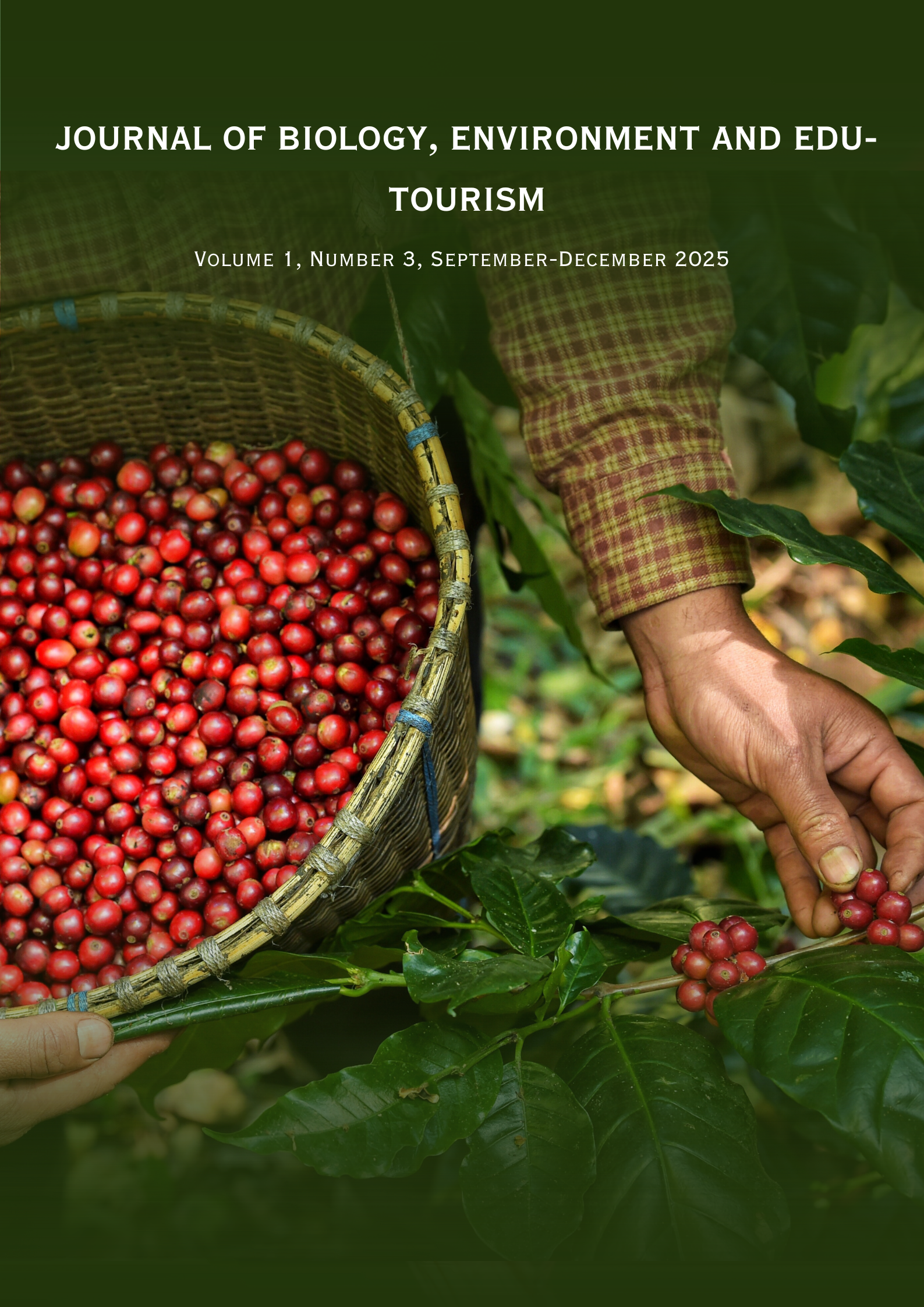
Development of community-based coffee agrotourism in West Nusa Tenggara province
DOI:
10.65622/jbee.v1i3.166Downloads
Abstract
Sustainable rural development requires strategies that optimise local resources while maintaining environmental and socio-cultural sustainability. The purpose of this study is to analyze the development of community-based coffee agrotourism in East Lombok Regency, West Nusa Tenggara Province, as a strategy to strengthen sustainable rural economic development. The research method uses a qualitative descriptive approach from secondary data to analyze the biophysical potential of local coffee-based agroecosystems, the institutional readiness of farmer groups and regional organizations, and existing collaboration mechanisms between government, communities, academics, and private actors. The results indicate that East Lombok has the potential to be developed into coffee agrotourism based on its natural and socio-cultural conditions, agricultural climate, farming communities, and local traditions. Obstacles faced include tourism infrastructure, community management capacity, and weak coordination between institutions. The recommended model to overcome the difficulties of agrotourism development is Community-Based Tourism (CBT), which integrates economic, socio-cultural, and ecological dimensions. In addition, cross-sector collaboration (quadruple helix) is needed to ensure a stable distribution of economic and environmental benefits. Therefore, the results of this study provide a practical basis for planning and policy-making related to the development of inclusive and sustainable agrotourism.
Keywords:
agrotourism coffee empowerment community sustainabilityReferences
Ariyanto, A., Welsa, H., & Lukitaningsih, A. (2025). The effect of local coffee commodities and community-based tourism on tourist satisfaction in Nglinggo Tourism Village, Yogyakarta: the mediating role of service quality. TEMALI: Jurnal Pembangunan Sosial, 8(2), 218–231. https://doi.org/ 10.15575/jt.v8i2.45097
Basalamah, A., Abdillah, F., Susanto, S., Permata, S., & Windawaty, H. (2023). Coffee tourism development potential in Banyuwangi Regency, East Java. Sadar Wisata: Jurnal Pariwisata, 6(2), 83–88. https://doi.org/10.32528/sw.v6i2.1219
Bhakti, A. D. P., Ageng, P. H., Styo, W. N. F., Fuad, N. M., & Gumoyo, N. (2025a). Integrating Design thinking into educational program development to promote sustainable coffee edu-tourism in rural Indonesia: a case study of Sumbertangkil village. KEMBARA: Jurnal Keilmuan Bahasa, Sastra, dan Pengajarannya, 11(2). https://doi.org/10.22219/kembara.v11i2.42127
Bhakti, A. D. P., & Nasvian, M. F. (2025b). Applying the brand identity prism to the development of a sustainable coffee edutourism destination in Sumbertangkil village, Malang, Indonesia. INJECT (Interdisciplinary Journal of Communication), 10(2), 67–92. https://doi.org/10.18326/inject.v10i2.4751
BPS. (2025). Luas Areal Tanaman Perkebunan Rakyat Menurut Jenis Tanaman di Provinsi Nusa Tenggara Barat (ribu ha), 2024.
Darmawan, K. K., Astawa, I. P., & Budarma, I. K. (2024). Pengembangan agrowisata berbasis nilai sosial budaya dan potensi alam di Desa Sidetapa Baliaga, Buleleng, Bali. Journal of Social Service and Empowerment, 1(1), 12–21. https://doi.org/10.56743/josse.v1i1.413
Harahap, R. H., Rauf, A., Sadalia, I., Aulia, F., Nasution, A. A., & others. (2025). Adoption of good agricultural practices (gap) among Arabica coffee farmers in Simalungun, Indonesia. Research on World Agricultural Economy, 191–204. https://doi.org/10.36956/rwae.v6i4.1897
Harudin, H., Nasrun, N., Normayasari, N., Ikhsan, N., Isman, K., Sahari, S., Admaja, A. K., Musrianton, M., Ferlin, A., Norsa, L. O. M., & others. (2025). strategi pengembangan agrowisata pesisir berbasis partisipasi komunitas di Desa Liya Togo. Jurnal Ilmu Manajemen Sosial Humaniora (JIMSH), 7(2), 169–180. https://doi.org/10.51454/jimsh.v7i2.1162
Hidayat, F. R., Hakim, L., & Parmawati, R. (2023). Analysis of community-based coffee agro-tourism sustainability in East Java, Indonesia. Habitat, 34(1), 1–12. https://doi.org/10.21776/ub.habitat.2023.034.1.1
Karyani, T., Djuwendah, E., Sadeli, A. H., Marlina, I., & others. (2018). Penumbuhkembangan agribisnis kopi arabica java preanger: dari pangalengan ke pasar dunia (studi kasus di koperasi produsen kopi Margamulya). Jurnal Agribisnis Terpadu, 11(1), 15–29. http://dx.doi.org/10.33512/jat.v11i1.5081
Ketut, K. S., Swandewi, D. M. M., Pratama, I. G. D. Y., & Widnyana, I. K. (2023). Coffee agrotourism development strategy in Belok Sidan Village, Petang District, Badung regency. International Journal of Applied Sciences in Tourism and Events, 7(2), 170–181. https://doi.org/10.31940/ijaste.v7i2.170-181
Kurniatun, E., Hakim, L., & Pangestuti, E. (2023). Strategy of kopi Sembalun agro-tourism (study in Sembalun Village, East Lombok regency, NTB). The International Journal of Accounting and Business Society, 31(1), 9–18. https://doi.org/10.21776/ijabs.2023.31.1.741
Lane, B., & Kastenholz, E. (2015). Rural tourism: the evolution of practice and research approaches--towards a new generation concept? Journal of Sustainable Tourism, 23(8–9), 1133–1156. https://doi.org/10.1080/09669582.2015.1083997
Mangku, I. G. P., & Mahayana, I. M. A. (2023). Improving coffee processing towards community-based agritourism. AJARCDE (Asian Journal of Applied Research for Community Development and Empowerment), 7(3), 78–82. https://doi.org/10.29165/ajarcde.v7i3.316
Mulyono, A. E., Apnitami, P., Wangi, I. S., Wicaksono, K. N. P., & Apriono, C. (2022). The potential of smart farming IoT implementation for coffee farming in Indonesia: a systematic review. Green Intelligent Systems and Applications, 2(2), 53–70. https://doi.org/10.53623/gisa.v2i2.95
Narimawati, U., Syafei, M. Y., Feriyansyah, A., & Maryadi, Y. (2025). Promotion of robusta coffee agrotourism in Pagar Alam City, South Sumatra. International Journal Of Community Service, 5(3), 354–358. https://doi.org/10.51601/ijcs.v5i3.868
Nasvian, M. F., Rosyida, H. N., & Aditya, C. S. K. (2025). Digital discourse and cultural narratives: a corpus-based analysis of coffee tourism in Indonesia on Twitter. Inject (interdisciplinary journal of communication), 10(1), 593–620. https://doi.org/10.18326/inject.v10i1.4434
Noknoi, C. (2016). Agritourism: concept and experiences. University of the Thai Chamber of Commerce. Journal Humanities and Social Sciences, 36(2), 157–169. https://so06.tci-thaijo.org/index.php/utccjournalhs/article/view/185961
Nono, E. A. L., Patiung, M., & Sastryawanto, H. (2024). Sustainable tourism through coffee: agrotourism development in Turekisa village, East Nusa Tenggara. 3(1), 40–48. https://doi.org/10.62394/scientia.v3i1.101
Novikarumsari, N. D., & Subekti, S. (2022). Empowering Gombengsari coffee farmers towards sustainable agrotourism. Agrisocionomics: Jurnal Sosial Ekonomi Pertanian, 6(2), 224–229. https://doi.org/10.14710/agrisocionomics.v6i2.13807
Pangestuti, E., Hanum, L., & Wahyudi, L. E. (2018). Development of agrotourism potential in Kampung Kopi Amadanom, Malang. Journal of Indonesian Tourism and Development Studies, 6(3), 194–199. https://doi.org/10.21776/ub.jitode.2018.006.03.06
Paramita, I. B. G. (2024). Transpormasi menuju agrowisata berbasis kearifan lokal: Tantangan dan Peluang Desa Panji Anom, Kabupaten Buleleng. Cultoure: Jurnal Ilmiah Pariwisata Budaya Hindu, 5(2), 156–166. https://journal.mpukuturan.ac.id/index.php/cultoure/article/view/360
Parining, N., Putra, I. G. S. A., & Diantari, I. G. A. P. (2024). Participation of coffee farmers in developing agrotourism. International Journal of Life Sciences and Earth Sciences, 7(1), 102–109. https://doi.org/10.21744/ijle.v7n1.2321
Prasetyanto, N. W., Setiawan, I., Djuwendah, E., & Suhartini, S. (2025). Emerging issues in the development of agritourism in Indonesia: a bibliometric analysis. SEPA: Jurnal Sosial Ekonomi Pertanian Dan Agribisnis, 22(2), 207–221. https://doi.org/10.20961/sepa.v22i2.106970
Pratiwi, J. R. (2019). Pengembangan Agrowisata Kebun Kopi di Kawasan Agropolitan Kabupaten Pacitan. Universitas Brawijaya.
Pribadi, T., Mukhoyyaroh, N. I., Naim, A., Bintoro, W. A., & Setiawan, S. E. (2025). Community participation in the development of sustainable agriculture based on coffee plantations in Kalibaru District, Banyuwangi. The Indonesian Green Technology Journal. 13(1), 8-15. https://doi.org/10.21776/ub.igtj.2024.013.01.02
Ramonita, L., Yunus, U., & Husada, S. (2025). Pengembangan agrowisata dan pemberdayaan petani kopi di Ciwidey, Jawa Barat melalui pendampingan oleh akademisi. J-Dinamika: Jurnal Pengabdian Masyarakat, 10(1), 39–47. https://doi.org/10.25047/j-dinamika.v10i1.5736
Risvita, W., Parmawati, R., Mulyadi, F., & Mamilianti, W. (2023). Strategy and participation of coffee agro-tourism development in Wagir district, Malang Regency. Agrisocionomics: Jurnal Sosial Ekonomi Pertanian, 7(3), 550–562. https://doi.org/10.14710/agrisocionomics.v7i3.16517
Safirah, A. (2024). Agrowisata: menggabungkan pariwisata dan pertanian untuk pemberdayaan ekonomi pedesaan. Literacy Notes, 2(1), 692–705. https://share.google/RI4LflszPXvNM6Pu6
Satriawan, I. K., Pujaastawa, I. B. G., Sarjana, I. M., & Sadyasmara, C. A. B. (2025). Agrowisata: diversifikasi daya tarik wisata Bali. Deepublish.
Ety Setiawati, Annisaa Eka Warliati, & Yuke Hernawati. (2024). The coffee trail planning as an effort to develop coffee agrotourism in Cibeureum village, Kuningan regency. International Journal of Education, Language, Literature, Arts, Culture, and Social Humanities, 2(2), 28–38. https://doi.org/10.59024/ijellacush.v2i2.774
Shabrina, A. N., & Eristya, N. E. (2025). Community-based Gastrodiplomacy and coffee agrotourism: a case study of Kaliangkrik, Magelang. Aghna Nur Shabrina, 2 Nency Esha Eristya. Indonesia has often introduced a variety of Indonesian culinary specialties at international forums. At the G20 Summit. BHUVANA: Journal of Global Studies, 3(2), 138-165. DOI: https://doi.org/10.59408/bjgs.v3i2.233
Sunarto, B. P., Siswantoro, A., Izzati, E. M., & Jamroni, M. (2024). Pengembangan model pertanian kopi berbasis kawasan di dataran tinggi. Jurnal Ekonomi Pertanian Dan Agribisnis, 8(3), 1181–1191. https://share.google/nT5hOXcfcDEw1oPRP
Utami, V. Y., Yusuf, S. Y. M., & Mashuri, J. (2022). Penerapan community based tourism dalam pengembangan pariwisata berkelanjutan sebagai upaya pemberdayaan sosial ekonomi masyarakat. JCOMENT (Journal of Community Empowerment), 3(3), 219–226. https://doi.org/10.55314/tsg.v3i3.286
Wardani, P. A., & Farhan, M. (2024). The development of coffee agrotourism packages as a product innovation in Sidomulyo Tourism Village, Jember Regency. Journal of Indonesian Tourism and Development Studies, 12(2). https://jitode.ub.ac.id/index.php/jitode/article/view/584
Wiguna, I. M. R. S., Mustika, N. W. M., & Runa, I. W. (2022). Perancangan agrowisata kopi dengan pendekatan desain berkelanjutan Di Desa Pujungan, Pupuan, Tabanan, Bali. Undagi: Jurnal Ilmiah Jurusan Arsitektur Universitas Warmadewa, 10(2), 280–290. https://doi.org/10.26618/jumptech.v2i2.12576
Yudhari, I. D. A. S., Darwanto, D. H., Waluyati, L. R., & Mulyo, J. H. (2020). Multidimensional scaling: sustainability of arabika coffee agro-tourism in Kabupaten Bangli, Bali. Journal of Environmental Management & Tourism, 11(6), 1455–1465.https://doi.org/10.14505/jemt11.6(46).16
License
Copyright (c) 2025 Aida Muspiah, Intan Taufik, Amrullah

This work is licensed under a Creative Commons Attribution 4.0 International License.