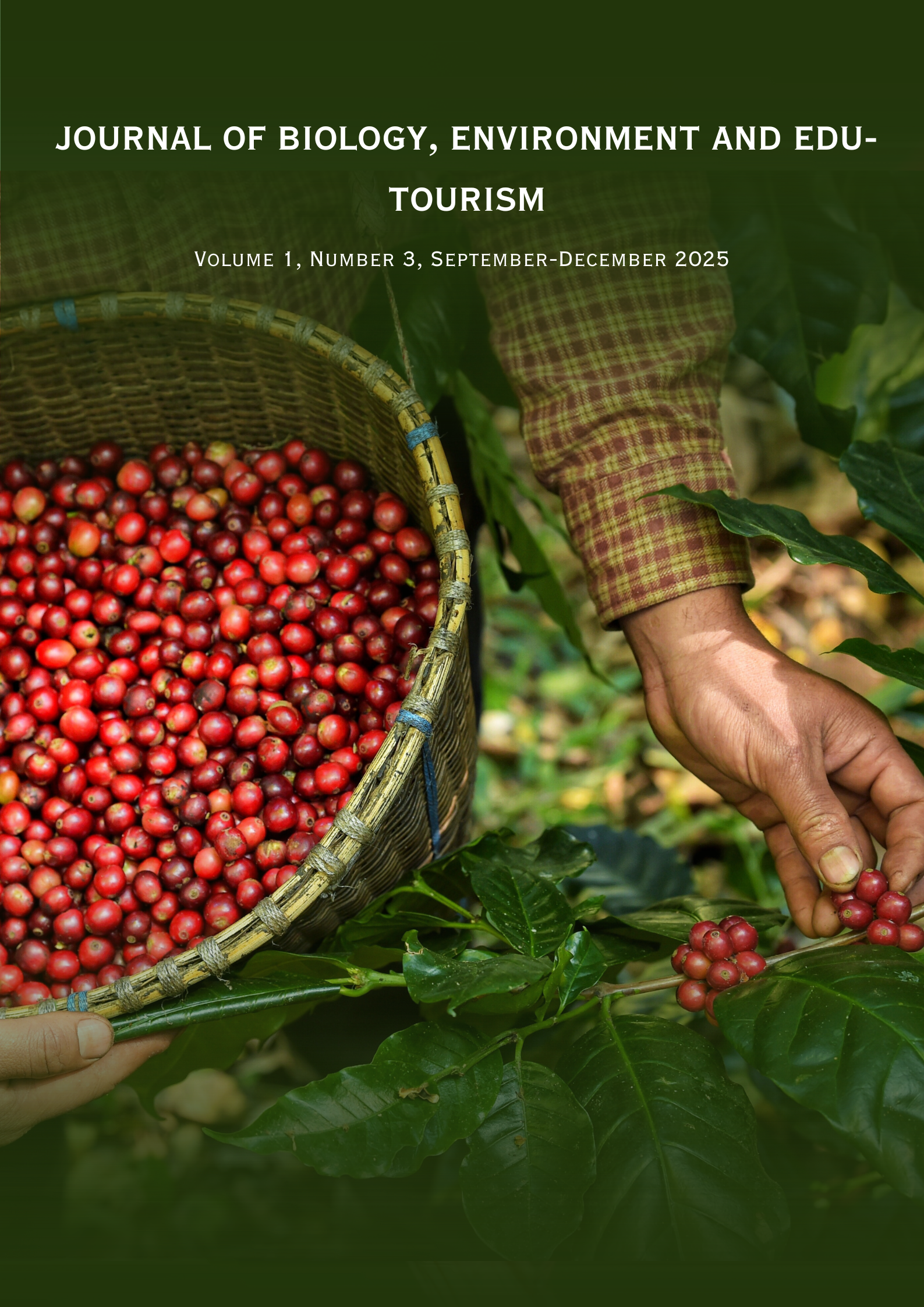
Integration of coastal urban farming for agrotourism development in the Ampenan heritage area
DOI:
10.65622/jbee.v1i3.194Downloads
Abstract
As part of efforts to promote sustainable tourism aligned with local cultural values, this study was conducted to formulate a development model for Green Heritage Tourism by integrating coastal urban farming within the Ampenan Heritage Area of Mataram City. A descriptive–qualitative approach was employed, supported by spatial analysis, field observations, in-depth interviews, and focus group discussions. The findings indicate that the Ampenan heritage area possesses significant historical and cultural value but faces ecological challenges, including coastal abrasion, limited green space, and increasing urban pressure. The integration of coastal urban farming, including hydroponics, vertical farming, and saline-tolerant crops, is considered effective in enhancing environmental quality, expanding productive green spaces, and enriching educational tourism attractions. Community participation is a crucial factor in the implementation process. This study develops a model comprising three pillars: heritage preservation, productive coastal ecology, and local economic empowerment. As a recommendation, local government and stakeholders are encouraged to adopt this model as a reference for policy formulation and revitalization strategies to ensure that Ampenan grows into a more adaptive, sustainable, and competitive heritage-based tourism destination.
Keywords:
Ampenan coastal urban farming Green heritage tourism heritage district revitalizationReferences
Buckley, R. (2023). Tourism and mental health: Foundations, frameworks, and futures. Journal of Travel Research, 62(1), 3-20., 29(2), 205–210. https://us.sagepub.com/en-us/journals-permissions
Creswell, J. W. (2018). Research design: Qualitative, quantitative, and mixed methods approaches (5th ed.). SAGE Publication: California.
Duy, P. N., Chapman, L., Tight, M., Thuong, L. V., & Linh, P. N. (2018). Urban resilience to floods in coastal cities. Journal of Urban Planning and Development, 144(1), 05017018. https://doi.org/10.1061/(ASCE)UP.1943-5444.0000419
Fauzia, A. (2024). Urban agriculture as an ecosystem services provider: A review. Sustainable Urban Development Journal, 8(1), 55–70. https://doi.org/10.61511/hjtas.v2i1.2024.785
Gómez-Villarino, M. T. (2021). Key insights of urban agriculture for sustainable cities: A systematic review. Agronomy for Sustainable Development, 41(3), 45. https://doi.org/10.1080/21683565.2021.1917471?urlappend=%3Futm_source%3Dresearchgate.net%26utm_medium%3Darticle
Hall, C. M. (2005). Tourism: Rethinking the social science of mobility. Pearson.
Helms, M. M., & Nixon, J. (2010). Exploring SWOT analysis. Journal of Strategy and Management, 3(3), 215–251. https://doi.org/10.1108/17554251011064837
Ilmiawan, I., & Sarah, F. M. (2025). Masyarakat Bugis di Kota Tua Ampenan Mataram. Fajar Historia, 9(1), 16–28. https://doi.org/10.29408/fhs.v9i1.27349
Khadijah, U. L. S. (2024). Community participation in preserving historical heritage in Indonesian heritage towns. Journal of Local Studies, 14(2), 55–70. https://doi.org/10.55908/sdgs.v12i1.2504
Kusno, A. (2013). After the new order: Space, politics and Jakarta. University of Hawai‘i Press.
Liburd, J. J., Duedahl, E., & Heape, C. (2022). Co-designing tourism for sustainable development. Journal of Sustainable Tourism, 30(10), 2298–2317. https://doi.org/10.1080/09669582.2020.1839473?urlappend=%3Futm_source%3Dresearchgate.net%26utm_medium%3Darticle
Lincoln, Y. S., & Guba, E. G. (1985). Naturalistic inquiry. SAGE.
Logan, W. (2020). Managing cultural heritage in Asian cities. Journal of Urban History, 46(1), 181–188. https://doi.org/10.1177/0096144219873341?urlappend=%3Futm_source%3Dresearchgate.net%26utm_medium%3Darticle
Mahsunah, N., Kurniawan, A., & Putri, R. (2023). Heritage-based tourism and local empowerment in Indonesian coastal towns. Tourism and Society Review, 14(2), 85–102.
Miles, M. B., Huberman, A. M., & Saldaña, J. (2014). Qualitative data analysis: A methods sourcebook (3rd ed.). SAGE.
Mirza, M. N. E. E., Waseem, H. B., & Rana, I. A. (2025). Urban agriculture and sustainability: A systematic review. World Development Sustainability, 7, 100245. DOI: https://doi.org/10.1016/j.wds.2025.100245
Mok, H. F., Williamson, V. G., Grove, J. R., Burry, K., Barker, S. F., & Hamilton, A. J. (2014). Strawberry fields forever? Urban agriculture in developed countries: a review. Agronomy for sustainable development, 34(1), 21-43. https://doi.org/10.1007/s13593-013-0156-7
Mugerauer, R. (2010). Toward a theory of integrated urban ecology. Ecology and Society, 15(4), 1–9. https://doi.org/10.5751/ES-03667-150431
Nugroho, I., Negara, P., & Yuniar, H. (2022). Heritage tourism development in Indonesian coastal areas. International Journal of Heritage Studies, 28(4), 512–527. https://doi.org/10.31328/jsed.v1i1.532
Orsini, F., Pennisi, G., Michelon, N., Minelli, A., Bazzocchi, G., Sanyé-Mengual, E., & Gianquinto, G. (2020). Multifunctional urban agriculture in the Global North. Frontiers in Sustainable Food Systems, 4, 562513. https://doi.org/10.3389/fsufs.2020.562513
Prain, G., Simon, D., & Halliday, J. (2021). Investment priorities for research in urban agriculture. Agronomy for Sustainable Development, 41(2), 28. https://doi.org/10.3389/fsufs.2022.965011
Pratiwi, D. I., Zahra, J. A. A., & Aliyah, I. (2022). Konservasi Kawasan Heritage. Cakra Wisata, 23(2), 34–52. https://jurnal.uns.ac.id/cakra-wisata/article/download/70114/39668
Reuters. (2021). Investors seed indoor farms as pandemic disrupts food supplies. Reuters News Service, February 18.
Robbani, F. F., Puna, S. H., Lestariningsih, W. A., & Larasati, C. E. (2024). Analisis geomorfologi pesisir Ampenan. Geomedia, 22(1). https://doi.org/10.21831/gm.v22i1.69715
Setiawan, A., & Rahmawati, D. (2021). Green heritage tourism in Indonesian coastal cities. Journal of Tourism Insights, 11(2), 45–59.
Sharpley, R. (2023). Sustainable tourism governance: Local or global? Journal of Sustainable Tourism, 31(4), 755–770. https://doi.org/10.1080/02508281.2022.2040295
Snyder, H. (2019). Literature review as a research methodology. Journal of Business Research, 104, 333–339. https://doi.org/10.1016/j.jbusres.2019.07.039
Specht, K., Siebert, R., Hartmann, I., Freisinger, U. B., Sawicka, M., Werner, A., Thomaier, S., Henckel, D., Walk, H., & Dierich, A. (2014). Urban agriculture of the future: an overview of sustainability aspects of food production in and on buildings. Agriculture and human values, 31(1), 33-51. https://doi.org/10.1007/s10460-013-9448-4
Timothy, D. J., & Boyd, S. W. (2015). Heritage tourism (2nd ed.). Routledge.
Tranfield, D., Denyer, D., & Smart, P. (2003). Towards a methodology for evidence-informed knowledge. British Journal of Management, 14(3), 207–222. https://doi.org/10.1111/1467-8551.00375?urlappend=%3Futm_source%3Dresearchgate.net%26utm_medium%3Darticle
Weaver, D. (2007). Sustainable tourism. Routledge.
License
Copyright (c) 2025 Husnul Jannah, Habibi, Aida Muspiah, Siska Cicilia, Moegraturl Amaro

This work is licensed under a Creative Commons Attribution 4.0 International License.