Analysis of Ecotourism-Based Science Learning Materials: A Case Study of Tourism in Pemepek Village
DOI:
10.65622/jbee.v2i1.258Downloads
Abstract
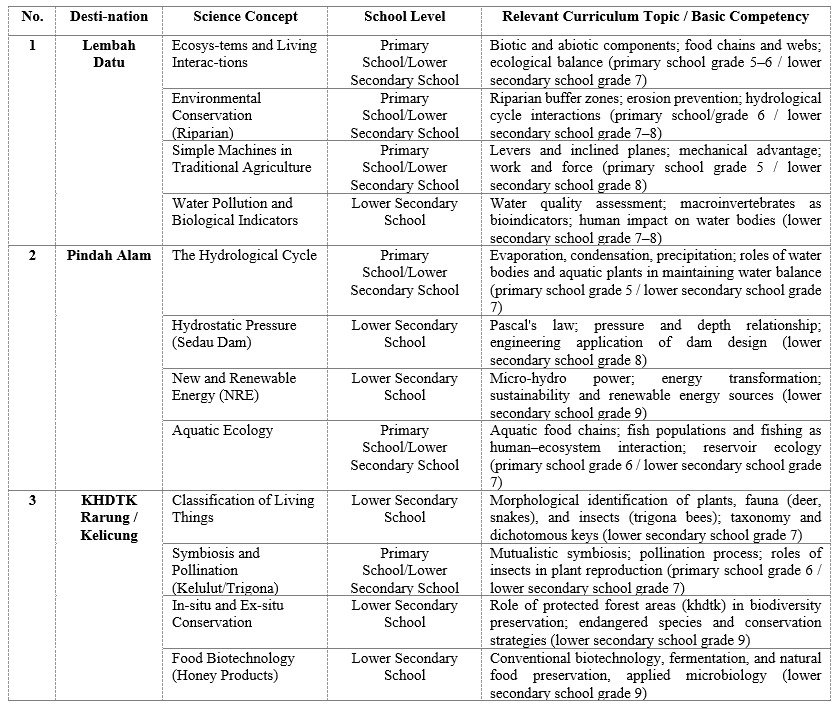
Despite the growing recognition of ecotourism as an educational resource, the systematic integration of local sites into formal science curricula remains underexplored in rural Indonesian contexts. This study analyzes the potential of three ecotourism destinations in Pemepek Village, Central Lombok: Lembah Datu, Pindah Alam, and Forest Area with Special Purpose (FAWSP) Rarung, or KHDTK Rarung, as contextual science learning materials for elementary and junior high school levels. Employing a qualitative descriptive approach, the research used field observations and science concept rubrics to identify educational themes and analyzed the data using the Miles and Huberman interactive model. The findings reveal that each site offers distinct scientific content: Lembah Datu provides insights into riparian ecosystems and simple machines; Pindah Alam facilitates learning on the hydrological cycle, hydrostatic pressure, and renewable energy; and KHDTK Rarung supports the study of biodiversity, symbiosis, and biotechnology. Collectively, these destinations function as "nature laboratories" that bridge abstract scientific theory with real-world observation. By synthesizing these findings, the research contributes an ethnoscience-based framework that guides educators in developing innovative, place-based curriculum strategies. Ultimately, this study demonstrates how local ecotourism can be transformed into a pedagogical tool to enhance scientific literacy through direct environmental engagement.
Keywords:
Ecotourism Science Education Pemepek Village Nature Laboratory, Contextual Learning.References
Abdussamad, Z. (2021). Metode Penelitian Kualitatif. Syakir Media Press.
Al Idrus, A., Gunada, I. W., Idawati, S., Nirmala, S. A., Yahdi, Y., Munib, M., & Dewi, E. S. (2025). Pengelolaan ekowisata mangrove berkelanjutan sebagai sarana edukasi dan pembelajaran IPA di Bale Mangrove Jerowaru Kabupaten Lombok Timur. Bioscientist: Jurnal Ilmiah Biologi, 13(2), 792-806. https://doi.org/10.33394/bioscientist.v13i2.14164
Al Idrus, A., Syukur, A., Mahrus, M., Zulkifli, L., & Santoso, D. (2019). Pengembangan ekowisata solusi matapencaharian masyarakat lokal dan strategi konservasi lingkungan di Desa Ketapang Raya Kecamatan Keruak, Lombok Timur. Jurnal Pengabdian Magister Pendidikan IPA, 2(2), 89-96. https://doi.org/10.29303/jpmpi.v2i1.361
Chau, M., & Arruzza, E. (2026). Learning through play: Educators’ autoethnography on gamification in medical radiation science. Journal of Medical Imaging and Radiation Sciences, 57(3), 102203. https://doi.org/10.1016/j.jmir.2026.102203
Cresswell, J. W. (2014). Research design: Qualitative, quantitative, and mixed methods approaches (4th Ed.). SAGE Publications.
Funa, A. A. (2026). Effectiveness of integrated STEM and problem-based learning in improving students’ conceptual understanding in science. Social Science & Humanities Open, 13, 102599. https://doi.org/10.1016/j.ssaho.2026.102599
Google Earth, (2026, March 7). Satellite imagery of Pemepek Village. Retrieved from https://earth.google.com/web/search/Pemepek,+Central+Lombok+Regency,+West+Nusa+Tenggara/
Hanafi, M., Muhlis, M. & Artayasa, I. P. (2025). Pengembangan modul pembelajaran IPA berbasis model Problem Based Learning (PBL) diintegerasikan dengan ekowisata sebau untuk meningkatkan kemampuan berpikir kritis peserta didik. Journal of Classroom Action Research, 7(Special Issue), 428-431. https://doi.org/10.29303/jcar.v7iSpecialIssue.11237
Hariani, R. (2024). Pengembangan materi ajar berbasis ekowisata mangrove dalam pembelajaran IPA: Review. Panthera: Jurnal Ilmiah Pendidikan Sains Dan Terapan, 4(3), 121–128. https://doi.org/10.36312/panthera.v4i3.298
Hassan, M. S., Ibrahim, M. S. N., Pengiran Bagul, A. H. B., Saikim, F. H., Yusrini, L., Mohd Zainol, R., & Mohd Yahya, A. S. (2026). Local community involvement and its impacts on ecotourism development in Borneo: A systematic review. Discover Environment, 4(1), 58. https://doi.org/10.1007/s44274-026-00579-6
Imaduddin, M., Sjöström, J., & Eilks, I. (2025). Implications of the concept of glocalization for science education for sustainability with a specific view on promoting water literacy. Science & Education, 1-33. https://doi.org/10.1007/s11191-025-00695-4
Jaswadi, J., Zaerani, W., & Rahmat, S. (2025). Sustainable seagrass management based on bioecological values in Sekotong. Journal of Biology, Environment, and Edu-Tourism, 1(3), 158–164. https://doi.org/10.65622/jbee.v1i3.179
Joshi, S., Panzer-Krause, S., Bucur, A., Atomulese, A., Zerbe, S., & Sauerwein, M. (2025). Exploring ecotourism in rural Romania: visitor perceptions in a Traditional Multifunctional Cultural Landscape. Environment Systems and Decisions, 45(2), 21. https://doi.org/10.1007/s10669-025-10007-4
Kurnia, R. P., & Suryadharma, I. G. (2016). Perangkat pembelajaran biologi kegiatan ecotourism untuk mengasah keterampilan proses sains dan sikap peduli lingkungan. Jurnal Inovasi Pendidikan IPA, 2(2), 230-240. https://doi.org/10.21831/jipi.v2i2.12252
Martin, N., Andayani, Y., & Hakim, A. (2025). Pengembangan e-modul ajar terintegrasi ekowisata gerabah dengan model pembelajaran etnopedagogi untuk melatih kemandirian belajar dan berpikir kritis peserta didik. Journal of Classroom Action Research, 7(4), 1696-1701. https://doi.org/10.29303/jcar.v7i4.13610
McKenna, T. J. (2025). Over a decade later: The role and place of outdoor education in the Australian national curriculum. Journal of Outdoor and Environmental Education, 1-17. https://doi.org/10.1007/s42322-025-00209-4
Miles, M. B., Huberman, A. M., & Saldana, J. (2014). Qualitative data analysis. SAGE.
Muliadi, I., Gunawan, G., Hudaini, L., & Gifari, P. (2025). Pengenalan PhET simulation: Pendorong eksplorasi mendalam dan motivasi belajar fisika di SMAN 4 Mataram. Indonesian Journal of Education and Community Services, 5(2), 75–80. https://journal.publication-center.com/index.php/ijecs/article/view/1892
Muliadi, I., & Yuliani, N. (2025). Literatur review: Analisis profil miskonsepsi pada peserta didik SMA pada materi fisika listrik dinamis. Indonesian Journal of Applied Science and Technology, 6(1), 38–45. https://journal.publication-center.com/index.php/ijast/article/view/2046
Nurhilallaily., Kautsar, M. S. A., Shani, L. H., Muayyadin, M., Khaerinnita, N., Kusumaninggrat, L. M., Awaludin., Muliani, S., Ramadani, P., Helmawati., & Rohani. (2025). Pendampingan pengelolaan website promosi wisata di Desa Pemepek Kecamatan Pringgarata Kabupaten Lombok Tengah. Jurnal Pengabdian Magister Pendidikan IPA, 8(1), 105-114. https://doi.org/10.29303/jpmpi.v8i1.10716
Paspania, K., Syukur, A., & Zulkifli, L. (2025). Development of LKPD based on mangrove ecosystem to improve ecotourism literacy of junior high school students on the south coast of Lombok Island. Jurnal Ilmiah Profesi Pendidikan, 10(1), 1-9. https://doi.org/10.29303/jipp.v10i1.3145
Subongkod, M., Sinlapasawet, W., Lalaeng, C., & Hongsakul, B. (2025). The impact of environmental and components of tourism on community participation in ecotourism: Evidence from the community leaders of Thailand. Procedia Computer Science, 263, 798-805. https://doi.org/10.1016/j.procs.2025.07.096
Sugiyono. (2023). Metode penelitian pendidikan. Alfabeta.
Suryaningsih, Y. (2018). Ekowisata sebagai sumber belajar biologi dan strategi untuk meningkatkan kepedulian siswa terhadap lingkungan. Bio Educatio, 3(2), 59-72. https://dx.doi.org/10.31949/be.v3i2.1142
Suryawan, I. W. K., Gunawan, V. D., & Lee, C. H. (2025). The role of local adaptive capacity in marine ecotourism scenarios. Tourism Management, 107, 105039. https://doi.org/10.1016/j.tourman.2024.105039
Suteja, I. W., Wahyuningsih, S., & Masyhudi, L. (2019). Potensi desa Pemepek sebagai kawasan wisata pedesaan berbasis lingkungan agraris di Kecamatan Pringgarata Kabupaten Lombok Tengah. Jurnal Ilmiah Hospitality, 8(2), 71-78. https://doi.org/10.47492/jih.v8i2.13
Syukur, A., Al Idrus, A., & Raksun, A. (2024). Pemanfaatan lingkungan mangrove sebagai sumber belajar IPA pada guru dan siswa Tsanawiyah Telage Bagik Desa Ketapang Raya Lombok Timur. Jurnal Pengabdian Magister Pendidikan IPA, 7(2), 330-335. https://doi.org/10.29303/jpmpi.v7i1.8235
Tien, N. D., Duyen, T. N. L., Huyen, N. T. T., Anh, P. Q., Oanh, N. T., Van Tich, V., Dat, D. T., Hanh, N. T. H. & Trang, V. H. (2024). Community-based ecotourism for sustainability: An evaluative analysis of Binh Son district, Quang Ngai province in Vietnam. Social Sciences & Humanities Open, 9, 100807. https://doi.org/10.1016/j.ssaho.2024.100807
Zhang, Y., Rehman, A. U., Nawal, A., Ullah, I., & Azman, N. B. (2026). From experience to image: How ecotourism experiences shape destination image through tourist engagement and value co-creation. Acta Psychologica, 263, 106292. https://doi.org/10.1016/j.actpsy.2026.106292
License
Copyright (c) 2026 Irman Muliadi, Ade Irama, M. Zannatun Naeem Zana

This work is licensed under a Creative Commons Attribution 4.0 International License.