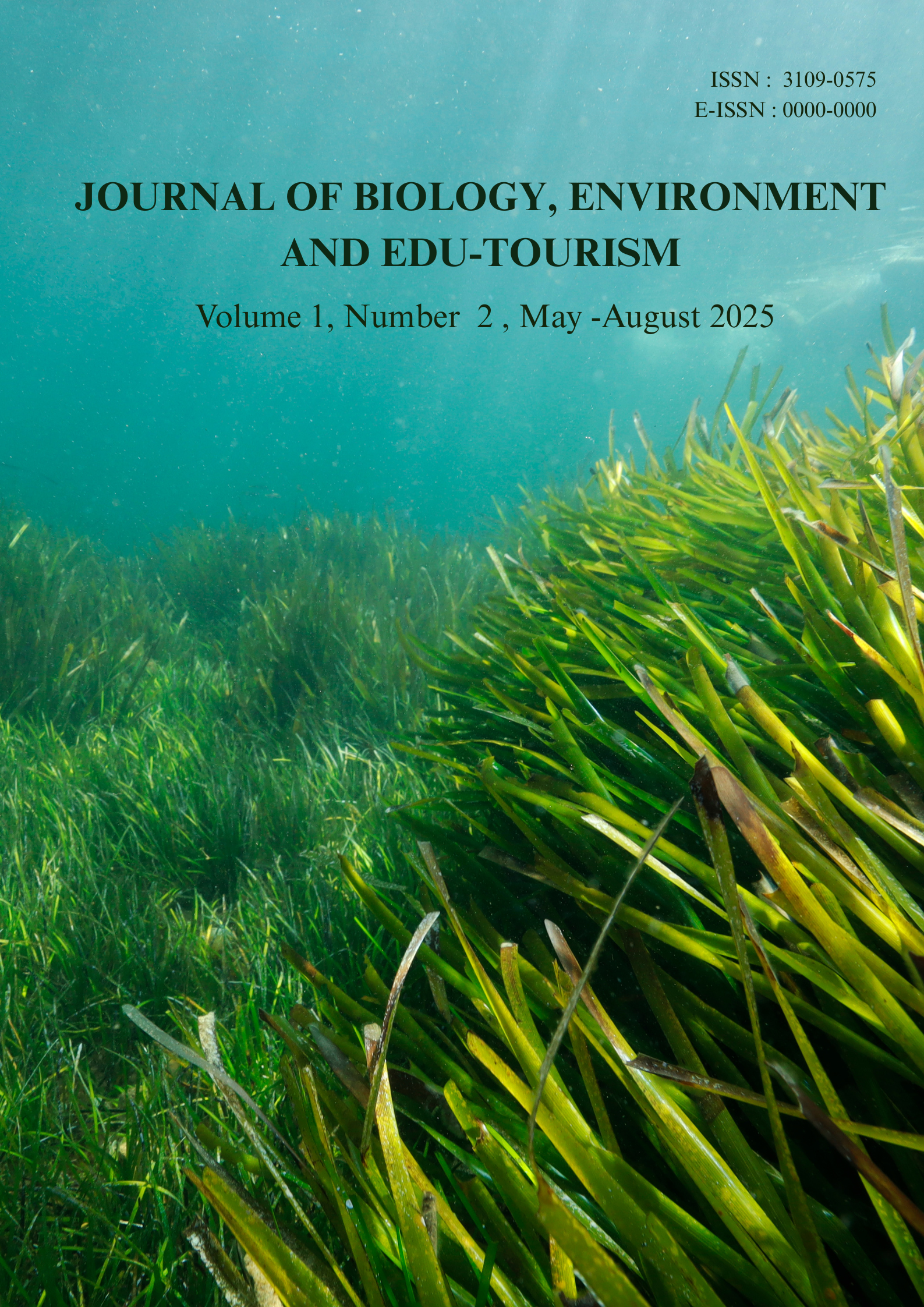
Exploring the Rich Diversity of Seagrass Species in Batu Kotak Coastal Ecosystem
Downloads
Abstract
Seagrass ecosystems play a pivotal role in maintaining coastal ecological balance, serving as critical habitats for marine biota, carbon sinks, and natural barriers against erosion. However, anthropogenic pressures increasingly threaten their sustainability. This study aims to assess seagrass diversity in Batu Kotak Beach, Central Lombok, to establish a foundational dataset for conservation efforts. Data were collected across three stations using a quadrat transect method (1×1 m) with three replicates per station. Analyzed parameters included species density, Shannon-Wiener diversity index (H’), evenness (e), and Simpson’s dominance index (C). Results revealed the presence of nine seagrass species, with the highest densities recorded for Syringodium (48 individuals) and Thalassia hemprichii (35 individuals). Diversity indices ranged from low (0.356) to moderate (1.536), with Station III exhibiting the most stable conditions (H’=1.00; e=0.900). Stations I and II displayed pronounced dominance of specific species (Padina tetrastromatica, dominance=0.83), suggesting ecological disturbances. Environmental factors such as water quality, substrate type, and human activities are hypothesized to drive these variations. The study recommends periodic monitoring for Stations I and II and designates Station III as a priority area for conservation.
Keywords:
Batu Kotak Beach biodiversity coastal conservation ecological indices SeagrassReferences
Bengen, D.G. (2003). Pedoman Teknis Pengenalan dan Pengelolaan Ekosistem Mangrove. Pusat Kajian Sumberdaya Pesisir dan Lautan IPB, 59.
Brower, J.E., J.H. Zar, and C.N. von Ende (1990). Field and Laboratory Methods for General Ecology. 3rded. Wm. C. Brown Publ., Dubuque. 237 pp.
Dhama, M. A., Akhhila, N., Saputra, M. S. D., Putra, M. R. P., & Simangunsong, T. (2023). Peranan Padang Lamun dalam Menjaga Kelestarian Ekosistem Laut Dangkal. MAIYAH, 2(4), 337-348. DOI: 10.20884/1.maiyah.2023.2.4.1005.
Duarte, C. M., Agusti, S., Barbier, E., Britten, G. L., Castilla, J. C., Gattuso, J. P., & Worm, B. (2020). Rebuilding marine life. Nature Geoscience, 13(8), 592– 598. https://doi.org/10.1038/s41561- 020-0617.
Duarte, C. M., Kennedy, H., Marbà, N., & Hendriks, I. (2020). Assessing the capacity of seagrass meadows for carbon burial: Current limitations and future strategies. Estuarine, Coastal and Shelf Science, 233, 106567. https://doi.org/10.1016/j.ecss.2020.10 6567.
Duffy, J. E., Cardinale, B. J., France, K. E., McIntyre, P. B., Thebault, E., & Loreau, M. (2019). Biodiversity and ecosystem functioning: the emergence of a synthetic ecological framework. Annual Review of Ecology, Evolution, and Systematics, 50, 17-44. https://doi.org/10.1146/annurevecolsys-110617-062349.
Erftemeijer, P. L. A., Lewis, R. R., & Christie, P. (2020). Seagrass restoration: state of the art and future prospects. Marine Pollution Bulletin, 159, 111452. https://doi.org/10.1016/j.marpolbul.20 20.111452.
Fourqurean, J. W., Duarte, C. M., Kennedy, H., Marbà, N., Holmer, M., Mateo, M. A., & Serrano, O. (2012). Seagrass ecosystems as a globally significant carbon stock. Nature Climate Change, 2(4), 289–294. https://doi.org/10.1038/nclimate1413.
Heck KL, Hays C, Orth RJ. (2003). A critical evaluation of the nursery role hypothesis for seagrass meadows. Marine Ecology Progress Series 253: 123–136. DOI: https://doi.org/10.3354/meps253123
Herliandi, L. (2011). Keanekaragaman, Sebaran, dan Karakteristik Lamun di Pantai Sancang, Kab. Garut. Skripsi Program Studi Biologi, Jurusan Pendidikan Biologi, Fakultas Matematika dan Ilmu Pengetahuan Alam, UPI Bandung: Tidak diterbitkan
Leefan, P. T. (2008). Kajian Komunitas Lamun di Pearairan Pesisir Manokwari (Tesis). Sekolah Pascasarjana IPB.
Maxwell, P. S., Eklöf, J. S., van Katwijk, M. M., O'Brien, K. R., de la Torre-Castro, M., Boström, C., & Wernberg, T. (2020). The fundamental role of ecological feedback mechanisms for the adaptive management of seagrass ecosystems. Biological Reviews, 95(4), 1202-1228. https://doi.org/10.1111/brv.12617.
McKenzie, L. J., Unsworth, R. K. F., & Nordlund, L. M. (2021). The global distribution of seagrass meadows. Global Ecology and Biogeography, 30(1), 119-134. https://doi.org/10.1111/geb.13169.
McMahon, K., Duarte, C. M., Lavery, P. S., & Mateo, M. Á. (2020). Global trends in seagrass recovery: A systematic review and meta-analysis. Frontiers in Marine Science, 7, 621. https://doi.org/10.3389/fmars.2020.00 621.
Nagelkerken, I., Sheaves, M., Baker, R., & Connolly, R. M. (2019). The seagrass fishery and biodiversity nexus. Fish and Fisheries, 20(6), 1137-1155. https://doi.org/10.1111/faf.12402.
Nordlund, L. M., Koch, E. W., Barbier, E. B., & Creed, J. C. (2020). Seagrass ecosystem services and their variability across genera and geographical regions. PLoS ONE, 15(5), e0235837. https://doi.org/10.1371/journal.pone.0 235837.
Orth, R. J., Luckenbach, M. L., Marion, S. R., Moore, K. A., & Wilcox, D. J. (2006). Seagrass recovery in the Delmarva coastal bays, USA. Aquatic Botany, 84(1), 26-36. DOI: https://doi.org/10.1016/j.aquabot.2005.07.007
Rasheed, M. A., Unsworth, R. K. F., & Chartrand, K. M. (2022). Global seagrass meadows: status, threats and conservation. Science of The Total Environment, 822, 153688. https://doi.org/10.1016/j.scitotenv.202 2.153688.
Short, F. T., Polidoro, B., Livingstone, S. R., Carpenter, K. E., Bandeira, S., Bujang, J. S., & Zieman, J. C. (2021). Extinction risk assessment of the world's seagrass species. Biological Conservation, 263, 109345. https://doi.org/10.1016/j.biocon.2021. 109345.
Strydom, S., Lee Long, W. J., & de Villiers, C. (2021). Changes in seagrass diversity and composition along a water quality gradient in a subtropical estuary. Estuarine, Coastal and Shelf Science, 255, 107347. https://doi.org/10.1016/j.ecss.2021.10 7347.
Unsworth, R. K. F., Nordlund, L. M., & CullenUnsworth, L. C. (2019). Seagrass meadows support global fisheries production. Conservation Letters, 12(1), e12566. https://doi.org/10.1111/conl.12566.
Walker, D. I., Kendrick, G. A., McComb, A. J., & de Iongh, H. H. (2020). Seagrass and macroalgal communities. In Seagrasses of Australia (pp. 70-102). Springer. https://doi.org/10.1007/978- 3-030-34403-5_4.
Waycott, M., Duarte, C. M., Carruthers, T. J., Orth, R. J., Dennison, W. C., Olyarnik, S., Calladine, A., Fourqurean, J. W., Heck, K. L., Jr, Hughes, A. R., Kendrick, G. A., Kenworthy, W. J., Short, F. T., & Williams, S. L. (2009). Accelerating loss of seagrasses across the globe threatens coastal ecosystems. Proceedings of the National Academy of Sciences of the United States of America, 106(30), 12377–12381. https://doi.org/10.1073/pnas.0905620106
License
Copyright (c) 2025 windiartipratiwiputri Nuraini, Febrisa Indri Utami, Novia Intan Cahyani, Lalu Syukran Muhsin, Zahira Rufaida, Ratna Permata Sari

This work is licensed under a Creative Commons Attribution 4.0 International License.