Determination of Honey Origin Using Mineral Profiling and Multivariate Statistical Analysis
DOI:
10.65622/ijtb.v2i1.270Downloads
Abstract
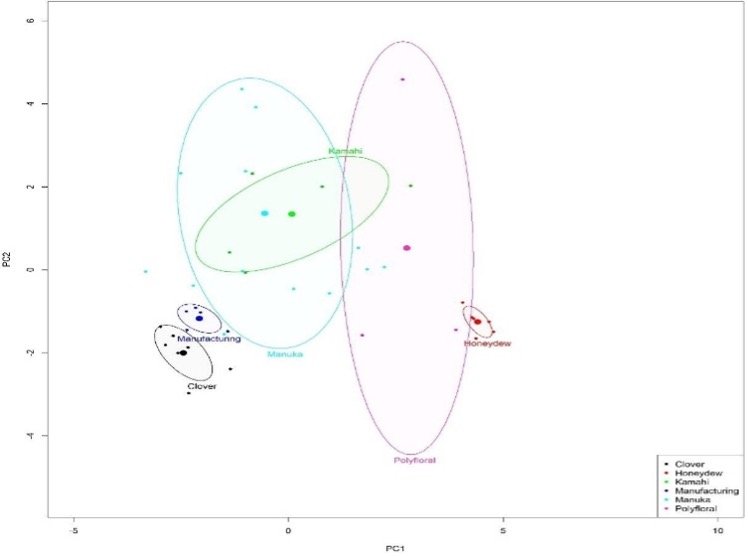
Honey authenticity and traceability have become increasingly important due to rising concerns over adulteration and mislabeling in the global market. This study aims to evaluate the potential of elemental composition for classifying honey from different origins using multivariate chemometric techniques. Six honey samples were analyzed for selected major and trace elements using spectrometric methods, followed by statistical evaluation through one-way ANOVA, Principal Component Analysis (PCA), and Hierarchical Cluster Analysis (HCA). The results showed significant differences in elemental concentrations, particularly calcium (Ca) and cesium (Cs) (p < 0.001), indicating strong discriminatory potential, while potassium (K) was dominant but highly variable. Univariate analysis exhibited limited classification capability due to overlapping distributions and small sample size. In contrast, chemometric approaches improved classification performance, where HCA showed partial clustering and PCA after standardization provided clearer separation among sample groups. This study concludes that multivariate analysis enhances the reliability of honey classification compared to univariate methods. The findings demonstrate that meaningful classification can be achieved using limited variables and small datasets, supporting the development of cost-effective and accessible approaches for honey authentication and traceability.
Keywords:
Chemometric analysis Honey authentication Trace elementsReferences
Abdelsalam, K. M. H., Shaalan, A. M., AbouEl-Soud, G. M., El-Dalil, M. A. E., Marei, A. M., El-Moneim, D. A., El-Banna, A. A. A., Lamlom, S. F., & Abdelghany, A. M. (2025). Comprehensive quality profiling and multivariate analysis of rice (Oryza sativa L.) cultivars: integrating physical, cooking, nutritional, and micronutrient characteristics for enhanced varietal selection. BMC Plant Biology, 25(1), 492. https://doi.org/10.1186/s12870-025-06438-5
Álvarez-Suárez, J. M., Majtan, J., Tejera, E., Santos-Buelga, C., & González-Paramás, A. M. (2025). The molecular identity of honey: toward reliable biochemical authentication. Trends in Food Science & Technology, 165, 105331. https://doi.org/10.1016/j.tifs.2025.105331
Alves, E., Gurupadayya, B. M., & Prabhakaran, P. (2025). Next-Generation Miniaturized Separation Platforms: Converging Detection, Automation, and Sustainable Design for Intelligent Analytical Science. Critical Reviews in Analytical Chemistry, 1–50. https://doi.org/10.1080/10408347.2025.2553122
Arredondo Montero, J. (2026). A Structured Guide to Univariate Test Selection Based on Normality, Variance Homogeneity, and Graphical Data Exploration. Journal of Surgical Research, 318, 230–240. https://doi.org/10.1016/j.jss.2025.10.053
Arteaga-Cabrera, E., Ramírez-Márquez, C., Sánchez-Ramírez, E., Segovia-Hernández, J. G., Osorio-Mora, O., & Gómez-Salazar, J. A. (2025). Advancing Optimization Strategies in the Food Industry: From Traditional Approaches to Multi-Objective and Technology-Integrated Solutions. Applied Sciences, 15(7), 3846. https://doi.org/10.3390/app15073846
Bao, Y., Cui, H., Tian, J., Ding, Y., Tian, Q., Zhang, W., Wang, M., Zang, Z., Sun, X., Li, D., Si, X., & Li, B. (2022). Novel pH sensitivity and colorimetry-enhanced anthocyanin indicator films by chondroitin sulfate co-pigmentation for shrimp freshness monitoring. Food Control, 131, 108441. https://doi.org/10.1016/j.foodcont.2021.108441
Biswas, A. P., Tasnim, M., Süfer, Ö., Das, S. C., Sarker, S., Zhang, M., & Islam, N. (2026). Honey adulteration detection: a comprehensive review of traditional and modern techniques. Journal of Food Measurement and Characterization, 20(4), 3929–3964. https://doi.org/10.1007/s11694-025-03954-8
Blanusa, M. L., López-Zurita, C. J., & Rasp, S. (2023). Internal variability plays a dominant role in global climate projections of temperature and precipitation extremes. Climate Dynamics, 61(3–4), 1931–1945. https://doi.org/10.1007/s00382-023-06664-3
Çatal, M. İ. (2025). Predicting macroelement content in legumes with machine learning. Scientific Reports, 15(1), 34656. https://doi.org/10.1038/s41598-025-22371-x
Chhikara, P., Jain, N., Tekchandani, R., & Kumar, N. (2022). Data dimensionality reduction techniques for Industry 4.0: Research results, challenges, and future research directions. Software: Practice and Experience, 52(3), 658–688. https://doi.org/10.1002/spe.2876
Danezis, G. P., Tsagkaris, A. S., Camin, F., Brusic, V., & Georgiou, C. A. (2016). Food authentication: Techniques, trends & emerging approaches. TrAC Trends in Analytical Chemistry, 85, 123–132. https://doi.org/10.1016/j.trac.2016.02.026
Das, A. (2026). Reliable water quality classification assessment and evaluating the influences of hydrochemistry variations using explainable multi-criteria and statistical models: implications for management strategies. Arabian Journal of Geosciences, 19(1), 18. https://doi.org/10.1007/s12517-025-12413-z
David, M., Hategan, A. R., Dehelean, A., Puscas, R., Cristea, G., Belc, N., Mustatea, G., & Magdas, D. A. (2025). Elemental and isotopic profile of honey – insights related to the nature of the exploited plant and potential environmental influences. Microchemical Journal, 219, 115965. https://doi.org/10.1016/j.microc.2025.115965
Deng, H.-H., Huang, K.-Y., Zhang, M.-J., Zou, Z.-Y., Xu, Y.-Y., Peng, H.-P., Chen, W., & Hong, G.-L. (2020). Sensitive and selective nitrite assay based on fluorescent gold nanoclusters and Fe2+/Fe3+ redox reaction. Food Chemistry, 317, 126456. https://doi.org/10.1016/j.foodchem.2020.126456
Doan, V. C. (2025). Rare earth elements in agroecosystems: a review of plant defenses and cascading effects on insect herbivores and pollinators. Journal of Plant Interactions, 20(1). https://doi.org/10.1080/17429145.2025.2581395
El Hajj, R., & Estephan, N. (2025). Advances in infrared spectroscopy and chemometrics for honey analysis: a comprehensive review. Critical Reviews in Food Science and Nutrition, 65(29), 6371–6384. https://doi.org/10.1080/10408398.2024.2439055
Ellis, J. D., Delaplane, K. S., Cline, A., & McHugh, J. V. (2008). The association of multiple sap beetle species (Coleoptera: Nitidulidae) with western honey bee ( Apis mellifera ) colonies in North America. Journal of Apicultural Research, 47(3), 188–189. https://doi.org/10.1080/00218839.2008.11101456
Francis, G. A., Jeyakumar, S. S., Ray, S., Supreethee, S., & Vashishth, R. (2025). Emerging roles of FTIR spectroscopy in toxic metal profiling: innovations for food safety monitoring. Food Safety and Risk, 12(1), 9. https://doi.org/10.1186/s40550-025-00119-9
Frigerio, J., Campone, L., Giustra, M. D., Buzzelli, M., Piccoli, F., Galimberti, A., Cannavacciuolo, C., Ouled Larbi, M., Colombo, M., Ciocca, G., & Labra, M. (2024). Convergent technologies to tackle challenges of modern food authentication. Heliyon, 10(11), e32297. https://doi.org/10.1016/j.heliyon.2024.e32297
Galić, L., Vukadinović, V., Nikolin, I., & Lončarić, Z. (2025). Soil Properties and Microelement Availability in Crops for Human Health: An Overview. Crops, 5(4), 40. https://doi.org/10.3390/crops5040040
Gürbüz, S., & Kıvrak, Ş. (2025). Comparative Evaluation of Machine Learning Models for Discriminating Honey Geographic Origin Based on Altitude-Dependent Mineral Profiles. Applied Sciences, 15(22), 11859. https://doi.org/10.3390/app152211859
Haider, A., Iqbal, S. Z., Bhatti, I. A., Alim, M. B., Waseem, M., Iqbal, M., & Mousavi Khaneghah, A. (2024). Food authentication, current issues, analytical techniques, and future challenges: A comprehensive review. Comprehensive Reviews in Food Science and Food Safety, 23(3). https://doi.org/10.1111/1541-4337.13360
Hajian-Tilaki, A., Kenari, R. E., Farahmandfar, R., & Razavi, R. (2024). Comparative study of physiochemical properties in Iranian multi-floral honeys: Local vs. commercial varieties. Heliyon, 10(17), e37550. https://doi.org/10.1016/j.heliyon.2024.e37550
Halimatussoleha, S., Jihad, B., Hadi, M. S., & Prianto, D. (2026). Science Reading Habits, Learning Interest, and Their Effect on Students’ Academic Achievement. Indonesian Journal of Educational Innovation, 2(1), 21–29. https://doi.org/10.65622/ijei.v2i1.242
Hu, W., Qian, L., Hong, M., Zhao, Y., & Fan, L. (2025). An Improved Anticipated Learning Machine for Daily Runoff Prediction in Data-Scarce Regions. Mathematical Geosciences, 57(1), 49–88. https://doi.org/10.1007/s11004-024-10154-5
Inaudi, P., Garzino, M., Abollino, O., Malandrino, M., & Giacomino, A. (2025). Honey: Inorganic Composition as Possible Marker for Botanical and Geological Assignment. Molecules, 30(7), 1466. https://doi.org/10.3390/molecules30071466
Jaeger, A., & Banks, D. (2023). Cluster analysis: A modern statistical review. WIREs Computational Statistics, 15(3). https://doi.org/10.1002/wics.1597
Kim, J., Kim, H., Kim, H., Lee, D., & Yoon, S. (2025). A comprehensive survey of deep learning for time series forecasting: architectural diversity and open challenges. Artificial Intelligence Review, 58(7), 216. https://doi.org/10.1007/s10462-025-11223-9
Kimindu, V. A., Choi, H., & Woo, S. (2025). Apis mellifera Honey Varieties in Kenya: Legislation, Production, Processing, and Labeling. Agriculture, 15(22), 2400. https://doi.org/10.3390/agriculture15222400
Kristína Predanócyová, & Peter Šedík. (2024). Honey Market Challenges: Flavored Honey As Healthy Food Choice For Consumers. Journal of Microbiology, Biotechnology and Food Sciences, e11021. https://doi.org/10.55251/jmbfs.11021
Li, X., Chen, Y., Tan, X., Sun, W., Cao, W., Li, B., Jiang, J., Qin, Y., Liu, Y., & Song, Y. (2026). Global Variations in Volatile Compounds of Mead From Major Production Regions: Chemical Profiling, Analytical Techniques, and Regional Influences. Comprehensive Reviews in Food Science and Food Safety, 25(1). https://doi.org/10.1111/1541-4337.70385
Liaqat, I., Ali, N. M., Andleeb, S., Naseem, S., Ali, S., & Aftab, M. N. (2025). Global Perspectives and Challenges: Global Perspectives on Honey Standard, Market Challenges, and Opportunities in the Honey Industry. In Pure Honey: Assurance & Authentication (pp. 369–407). Springer Nature Switzerland. https://doi.org/10.1007/978-3-031-98913-1_14
Liu, P., Yuan, H., Ning, Y., Chakraborty, B., Liu, N., & Peres, M. A. (2024). A modified and weighted Gower distance-based clustering analysis for mixed type data: a simulation and empirical analyses. BMC Medical Research Methodology, 24(1), 305. https://doi.org/10.1186/s12874-024-02427-8
Négrel, P., Ladenberger, A., Reimann, C., Birke, M., & Sadeghi, M. (2018). Distribution of Rb, Ga and Cs in agricultural land soils at European continental scale (GEMAS): Implications for weathering conditions and provenance. Chemical Geology, 479, 188–203. https://doi.org/10.1016/j.chemgeo.2018.01.009
Pacifico, L. R., Guarino, A., Iannone, A., & Albanese, S. (2025). Accounting for the Compositional Nature of Geochemical Data to Improve the Interpretation of Their Univariate and Multivariate Spatial Patterns: A Case Study from the Campania Region (Italy). Geosciences, 15(1), 20. https://doi.org/10.3390/geosciences15010020
Pandhi, S., & Kumar, A. (2025). Assessing the influence of extraction techniques on the phytochemical composition of green coffee (Coffea arabica) using principal component analysis (PCA) and hierarchical cluster analysis (HCA). Journal of the Indian Chemical Society, 102(11), 102111. https://doi.org/10.1016/j.jics.2025.102111
Pereira, A. G., Fraga-Corral, M., García-Oliveira, P., Jimenez-Lopez, C., Lourenço-Lopes, C., Carpena, M., Otero, P., Gullón, P., Prieto, M. A., & Simal-Gandara, J. (2020). Culinary and nutritional value of edible wild plants from northern Spain rich in phenolic compounds with potential health benefits. Food & Function, 11(10), 8493–8515. https://doi.org/10.1039/D0FO02147D
POHL, P. (2009). Determination of metal content in honey by atomic absorption and emission spectrometries. TrAC Trends in Analytical Chemistry, 28(1), 117–128. https://doi.org/10.1016/j.trac.2008.09.015
Prananda, M., Mukhlis, A., & Alim, S. (2025). Effects of Light Spectrum Variation on Biomass Development of Caulerpa lentillifera. Indonesian Journal of Tropical Biology, 1(3), 156–162. https://doi.org/10.65622/ijtb.v1i3.147
Putu Eka Gunadi, Izzati, L. H., Nurasmi, I., & Houtave, E. (2026). Inventory of Butterfly Species and Diversity (Lepidoptera) in Mataram City. Journal of Biology, Environment, and Edu-Tourism, 2(1), 194–202. https://doi.org/10.65622/jbee.v2i1.237
Pytlakowska, K., Kita, A., Janoska, P., Połowniak, M., & Kozik, V. (2012). Multi-element analysis of mineral and trace elements in medicinal herbs and their infusions. Food Chemistry, 135(2), 494–501. https://doi.org/10.1016/j.foodchem.2012.05.002
Rosmiatinnafiz, E. R., Luthfiyannisa, & Fauzan, A. (2026). Mangrove Community Structure in the Bale Mangrove Ecotourism Area, East Lombok. Journal of Biology, Environment, and Edu-Tourism, 2(1), 220–228. https://doi.org/10.65622/jbee.v2i1.264
Samuel, A., & Merkebu, J. (2026). Exploring Sampling Strategies to Maximize Qualitative Research Studies in Adult Education. Adult Learning, 37(2), 89–99. https://doi.org/10.1177/10451595251349183
Santos-Buelga, C., & González-Paramás, A. M. (2025). Chemical Composition of Honey. In Bee Products – Chemical and Biological Properties (pp. 47–104). Springer Nature Switzerland. https://doi.org/10.1007/978-3-031-89049-9_3
Sapitri, R. D., Nurlatifah, N., & Riskayanti, Y. (2025). Cultural Integration in Science Education: Teachers’ Perceptions of The Sumbawa Oil (Melala) as Local Wisdom in Chemistry Learning. Indonesian Journal of Educational Innovation, 1(3), 7–13. https://doi.org/10.65622/ijei.v1i3.154
Schoder, D. (2026). Honey Fraud as a Moving Analytical Target: Omics-Informed Authentication Within a Multi-Layer Analytical Framework. Foods, 15(4), 712. https://doi.org/10.3390/foods15040712
Silva, M. F. E. da, Azevedo, E. P. de P., Gomes, R. V. R. de S., Amorim, M. M. C. de, Roque, K. T. da S., Farias, M. C. P. de, & Alves, E. M. dos S. (2025). Scientific trends and research networks on Apis mellifera honey: a bibliometric study (2018–2024). Observatório De La Economía Latinoamericana, 23(5), e9893. https://doi.org/10.55905/oelv23n5-058
Smith, K. E., Weis, D., Amini, M., Shiel, A. E., Lai, V. W.-M., & Gordon, K. (2019). Honey as a biomonitor for a changing world. Nature Sustainability, 2(3), 223–232. https://doi.org/10.1038/s41893-019-0243-0
Taha, M. M. E., Abdelwahab, S. I., Oraiby, M., & Al-Zubairi, A. S. (2025). Heavy Metals, Active Ingredients, and Adulteration Smokeless Tobacco Varieties: a Chemometrics Based on Principal Components and Hierarchical Cluster Analysis. Biological Trace Element Research, 203(12), 6044–6051. https://doi.org/10.1007/s12011-025-04623-z
Tibebe, D., Hussen, M., Mulugeta, M., yenealem, D., Moges, Z., Gedefaw, M., & Kassa, Y. (2022). Assessment of selected heavy metals in honey samples using flame atomic absorption spectroscopy (FAAS), Ethiopia. BMC Chemistry, 16(1), 87. https://doi.org/10.1186/s13065-022-00878-y
Udayani, N. W. A., Sasmita, V., Farhana, B. C. D., & Sumardi, L. (2025). An Analysis of the Impact of Child-Friendly School Culture Implementation on Students’ Collaboration Skills at West Nusa Tenggara, Indonesia. Indonesian Journal of Educational Innovation, 1(3), 40–46. https://doi.org/10.65622/ijei.v1i3.163
Zaman, J., Shoomal, A., Jahanbakht, M., & Ozay, D. (2025). Driving Supply Chain Transformation with IoT and AI Integration: A Dual Approach Using Bibliometric Analysis and Topic Modeling. IoT, 6(2), 21. https://doi.org/10.3390/iot6020021
License
Copyright (c) 2026 Pahmi Husain, Ana Restu Nirwana, Rangga Alif Faresta

This work is licensed under a Creative Commons Attribution 4.0 International License.