The Effect of Volume and Surface Area Ratio of Medium on Bacterial Cellulose Production at Different Fermentation Times by Gluconacetobacter sp. SAL53
DOI:
10.65622/ijtb.v2i1.278Downloads
Abstract
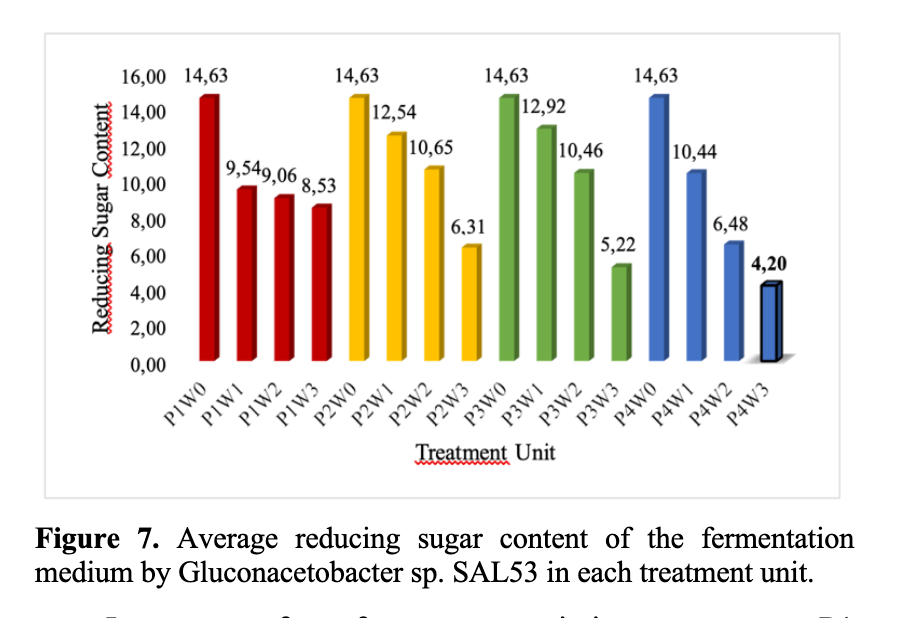
Bacterial cellulose is an extracellular polysaccharide synthesized by several bacterial genera, including Gluconacetobacter sp. SAL53, and has broad potential applications in biotechnology, food, and biomedical industries. Since this bacterium requires aerobic conditions, oxygen availability becomes a key factor influencing cellulose biosynthesis. The surface area of the fermentation medium affects oxygen transfer, while fermentation time determines the duration of bacterial metabolic activity and cellulose accumulation. This study aimed to evaluate the effects of different fermentation medium surface areas and fermentation durations on BC production. The experiment used four container diameters corresponding to surface areas of 78.5, 176.6, 314.0, and 490.6 cm², combined with fermentation periods of 5, 10, and 15 days. The results demonstrated that both surface area and fermentation time significantly influenced BC yield. Increased surface area and prolonged fermentation led to higher BC thickness, wet weight, and dry weight. The highest production was obtained under treatment P4W3, with a surface area of 490.6 cm² and a fermentation period of 15 days, yielding a thickness of 1.33 cm, wet weight of 415.5 g, and dry weight of 4.85 g. This condition was also characterized by a final pH of 3.89, the lowest reducing sugar content (5.22%), and the lowest remaining volume (350 mL), indicating optimal bacterial metabolism. These findings confirm that fermentation surface area and duration are critical factors for optimizing BC production.
Keywords:
Bacterial cellulose Fermentation surface area Gluconacetobacter spReferences
Ayu, H., Wardatullatifah S, I. S., Hidayat, S., & Jannah, M. (2025). Pineapple Waste Processing Design as Functional Food to Support Agrotourism in East Lombok, Indonesia. Indonesian Journal of Tropical Biology, 1(3), 122–130. https://doi.org/10.65622/ijtb.v1i3.192
Bancin, J. B. (2021). Pengaruh penambahan rumput laut merah (Gracilaria sp.) dan konsentrasi bakteri Acetobacter xylinum terhadap mutu nata de coco [Skripsi, Universitas Islam Negeri Ar-Raniry]. Repository UIN Ar-Raniry. https://repository.ar-raniry.ac.id/id/eprint/22951/
Bhatia, T., Bose, D., Sharma, D., & Patel, D. (2024). A Review on Cellulose Degrading Microbes and its Applications. Industrial Biotechnology, 20(1), 26–39. https://doi.org/10.1089/ind.2023.0025
Boby, C. A., Roni, A., & Muhsinin, S. (2021). Review: Produksi, karakterisasi dan aplikasi selulosa bakteri di bidang farmasi. Journal of Pharmacy and Science, 4(2), 12–28. https://ejurnal.stikesprimanusantara.ac.id/index.php/JPS
Candeiro, G. T. de M., Correia, F. C., Duarte, M. A. H., Ribeiro-Siqueira, D. C., & Gavini, G. (2012). Evaluation of Radiopacity, pH, Release of Calcium Ions, and Flow of a Bioceramic Root Canal Sealer. Journal of Endodontics, 38(6), 842–845. https://doi.org/10.1016/j.joen.2012.02.029
Couper, D. J., Hosking, J. D., Cisler, R. A., Gastfriend, D. R., & Kivlahan, D. R. (2005). Factorial designs in clinical trials: options for combination treatment studies. Journal of Studies on Alcohol, Supplement, (s15), 24–32. https://doi.org/10.15288/jsas.2005.s15.24
Cui, X., Lee, J. J. L., & Chen, W. N. (2019). Eco-friendly and biodegradable cellulose hydrogels produced from low cost okara: towards non-toxic flexible electronics. Scientific Reports, 9(1), 18166. https://doi.org/10.1038/s41598-019-54638-5
Demain, A. L. (2014). Importance of microbial natural products and the need to revitalize their discovery. Journal of Industrial Microbiology & Biotechnology, 41(2), 185–201. https://doi.org/10.1007/s10295-013-1325-z
Demain, A. L., & Adrio, J. L. (2008). Contributions of microorganisms to industrial biology. Molecular Biotechnology, 38(1), 41–55. https://doi.org/10.1007/s12033-007-9005-1
Fijalkowski, K., Zywicka, A., Drozd, R., Kordas, M., & Rakoczy, R. (2016). Effect of Gluconacetobacter xylinus cultivation conditions on the selected properties of bacterial cellulose. Polish Journal of Chemical Technology, 18(4), 117–123. https://doi.org/10.1515/pjct-2016-0076
Gomes, F. P., Silva, N. H. C. S., Trovatti, E., Serafim, L. S., Duarte, M. F., Silvestre, A. J. D., Neto, C. P., & Freire, C. S. R. (2013). Production of bacterial cellulose by Gluconacetobacter sacchari using dry olive mill residue. Biomass and Bioenergy, 55, 205–211. https://doi.org/10.1016/j.biombioe.2013.02.004
Gurevitch, J., & Chester, S. T. (1986). Analysis of Repeated Measures Experiments. Ecology, 67(1), 251–255. https://doi.org/10.2307/1938525
Hamad, A., Hidayah, B. I., Solekhah, A., & Septhea, A. G. (2017). Potensi kulit nanas sebagai substrat dalam pembuatan nata de pina. Jurnal Riset Sains dan Teknologi, 1(1), 9–14. https://journal.unusida.ac.id/index.php/jrst
Jarre, M., Petit-Boix, A., Priefer, C., Meyer, R., & Leipold, S. (2020). Transforming the bio-based sector towards a circular economy - What can we learn from wood cascading? Forest Policy and Economics, 110, 101872. https://doi.org/10.1016/j.forpol.2019.01.017
Lahiri, D., Nag, M., Dutta, B., Dey, A., Sarkar, T., Pati, S., Edinur, H. A., Kari, Z. A., Noor, N. H., & Ray, R. R. (2021). Bacterial cellulose: Production, characterization and application as antimicrobial agent. International Journal of Molecular Sciences, 22(23), 12984. https://doi.org/10.3390/ijms222312984
Nayak, S., Samanta, S., Mallick, N., & Satapathy, S. (2024). Enhanced bacterial cellulose production via genetic and metabolic engineering approaches: Recent advances and future prospects. Biotechnology for Biofuels and Bioproducts, 17(1), 48. https://doi.org/10.1186/s13068-024-02528-z
Palash, A., Piddubny, V., & Golovkina, L. (2019). Technical support of aerobic fermentation processes. Scientific Journal of Lutsk National Technical University, 16, 21–30. https://doi.org/10.36910/2312-0584-16-2019-002
Panjaitan, V. D., Iriany, & Sukeksi, L. (2024). Karakterisasi biofilm selulosa bakteri dengan modifikasi gliserol secara ex situ. Jurnal Teknik Kimia USU, 13(1), 17–23. https://doi.org/10.32734/jtk.v13i1.13560
Rautio, P., Lideskog, H., Bergsten, U., & Karlberg, M. (2023). Perspectives: Lean forestry – A paradigm shift from economies of scale to precise and sustainable use of ecosystem services in forests. Forest Ecology and Management, 530, 120766. https://doi.org/10.1016/j.foreco.2022.120766
Reese, E. T., Siu, R. G. H., & Levinson, H. S. (1950). THE BIOLOGICAL DEGRADATION OF SOLUBLE CELLULOSE DERIVATIVES AND ITS RELATIONSHIP TO THE MECHANISM OF CELLULOSE HYDROLYSIS. https://journals.asm.org/journal/jb
Rivas-Garcia, P., Martinez-Ramirez, A. R., Torres-Mendez, C., & Delgado-Dominguez, C. (2024). Kinetic modelling of bacterial cellulose production in a stirred tank bioreactor. Processes, 12(12), 2390. https://doi.org/10.3390/pr12122390
Sandelowski, M. (2000). Combining Qualitative and Quantitative Sampling, Data Collection, and Analysis Techniques in Mixed-Method Studies. Research in Nursing & Health, 23(3), 246–255. https://doi.org/10.1002/1098-240X(200006)23:3<246::AID-NUR9>3.0.CO;2-H
Santoso, S. P., Chou, C.-C., Lin, S.-P., Soetaredjo, F. E., Ismadji, S., Hsieh, C.-W., & Cheng, K. C. (2020). Enhanced production of bacterial cellulose by Komactobacter intermedius using statistical modeling. Cellulose, 27(5), 2497–2509. https://doi.org/10.1007/s10570-019-02961-5
Satyakti, Y. (2026). The Impact of Indonesia’s Biofuels Policy on the Food and Energy Security. https://doi.org/10.2139/ssrn.6012654
Sawatari, Y., Hirano, T., & Yokota, A. (2006). Development of food grade media for the preparation of Lactobacillus plantarum starter culture. The Journal of General and Applied Microbiology, 52(6), 349–356. https://doi.org/10.2323/jgam.52.349
Sawyer, S. F. (2009). Analysis of Variance: The Fundamental Concepts. Journal of Manual & Manipulative Therapy, 17(2), 27E-38E. https://doi.org/10.1179/jmt.2009.17.2.27E
Serrano, A. L. M., Rodrigues, G. A. P., Martins, P. H. dos S., Saiki, G. M., Filho, G. P. R., Gonçalves, V. P., & Albuquerque, R. de O. (2024). Statistical Comparison of Time Series Models for Forecasting Brazilian Monthly Energy Demand Using Economic, Industrial, and Climatic Exogenous Variables. Applied Sciences, 14(13), 5846. https://doi.org/10.3390/app14135846
Sharma, S., & Bhende, M. (2024). An overview: non-toxic and eco-friendly polysaccharides—its classification, properties, and diverse applications. Polymer Bulletin, 81(14), 12383–12429. https://doi.org/10.1007/s00289-024-05307-9
Singh, D., Chand, K., Sahal, A., Kumar, S., & Hussain, A. (2024). Optimization of fermentation parameters and their impact on the final properties of the cereal-legume-based fermented product. Journal of Stored Products Research, 106, 102302. https://doi.org/10.1016/j.jspr.2024.102302
Srivastava, S., & Mathur, G. (2024). Statistical optimization of bioprocess parameters for enhanced production of bacterial cellulose from K. saccharivorans BC-G1. Brazilian Journal of Microbiology, 55(3), 2199–2210. https://doi.org/10.1007/s42770-024-01397-9
Tsouko, E., Pilafidis, S., Kourmentza, K., Gomes, H. I., Sarris, G., Koralli, P., Papagiannopoulos, A., Pispas, S., & Sarris, D. (2024). A sustainable bioprocess to produce bacterial cellulose (BC) using waste streams from wine distilleries and the biodiesel industry: evaluation of BC for adsorption of phenolic compounds, dyes and metals. Biotechnology for Biofuels and Bioproducts, 17(1), 40. https://doi.org/10.1186/s13068-024-02488-3
Turganova, R., Tuleyeva, R., Belkozhayev, A., Gizatullina, N., Yelemessova, G., Taubatyrova, A., Mussalimova, M., Shynykul, Z., & Toleutay, G. (2025). Bacterial Cellulose for Sustainable Food Packaging: Production Pathways, Structural Design, and Functional Modification Strategies. Polymers, 17(23), 3165. https://doi.org/10.3390/polym17233165
Ujjwal, R. R., & Slaughter, G. (2025). Advances in Bacterial Cellulose‐Based Scaffolds for Tissue Engineering: Review. Journal of Biomedical Materials Research Part A, 113(4). https://doi.org/10.1002/jbm.a.37912
Wang, Y., Li, H., Zhu, M., Wu, A., Li, B., Yin, K., Xiong, R., Wu, F., & Kuang, K. (2026). Causal Inference with Complex Treatments: A Survey. ACM Computing Surveys, 58(9), 1–36. https://doi.org/10.1145/3789499
Wang, Y.-Y., Zhao, X.-Q., Li, D.-M., Wu, Y.-M., Wahid, F., Xie, Y.-Y., & Zhong, C. (2023). Review on the strategies for enhancing mechanical properties of bacterial cellulose. Journal of Materials Science, 58(39), 15265–15293. https://doi.org/10.1007/s10853-023-08803-x
Wang, Z.-G., Xiang, D., Wang, X.-B., & Li, C.-F. (2016). Preparation of an inoculum of Gluconacetobacter xylinus without mutants in shaken culture. Journal of Applied Microbiology, 121(3), 713–720. https://doi.org/10.1111/jam.13193
Wibowo, N. A., & Isroi. (2015). Potensi in-vivo selulosa bakterial sebagai nano-filler karet elastomer thermoplastics (ETPS). Perspektif, 14(2), 103–112. https://doi.org/10.21082/p.v14n2.2015.103-112.
Yassine, F., Bassil, N., Flouty, R., Chokr, A., Samrani, A. El, Boiteux, G., & Tahchi, M. El. (2016). Culture medium pH influence on Gluconacetobacter physiology: Cellulose production rate and yield enhancement in presence of multiple carbon sources. Carbohydrate Polymers, 146, 282–291. https://doi.org/10.1016/j.carbpol.2016.02.003
License
Copyright (c) 2026 Chaerina Wardiani Puspita, Sarkono, A.A. Ngurah Nara Kusuma, M. Zannatun Naeem Zana

This work is licensed under a Creative Commons Attribution 4.0 International License.