A Systematic Literature Review: The Role of Digital Media in Improving Student Science Literacy
Published:
2026-02-28Downloads
Abstract
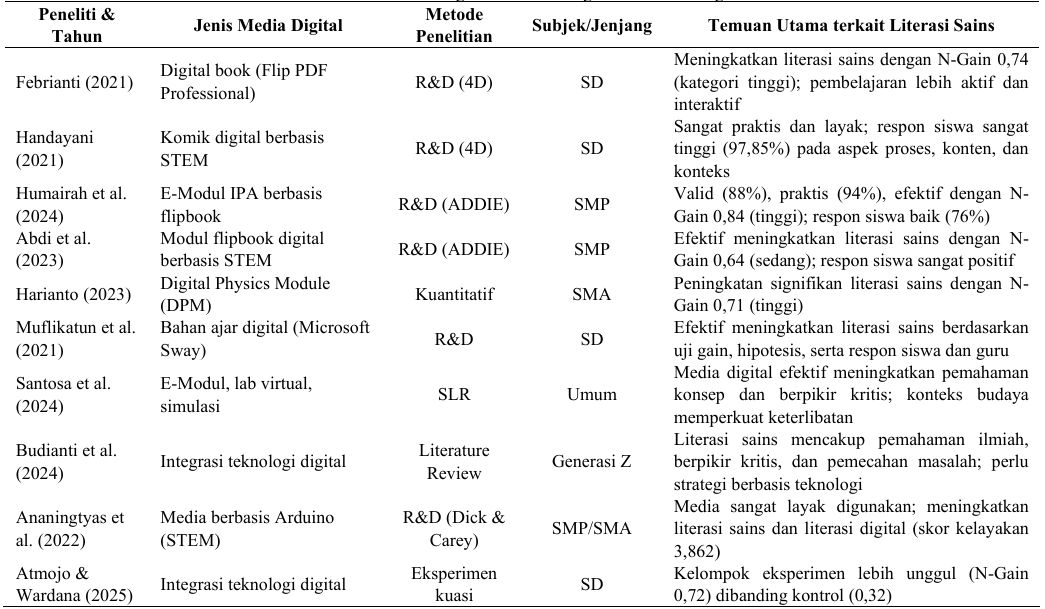
The low level of Indonesian students’ science literacy, as reflected in the PISA results, indicates the need for effective learning innovations through the integration of digital technology. This study aims to analyze the role of digital media in improving students’ science literacy. The research employed a Systematic Literature Review (SLR) method by analyzing ten relevant articles published between 2021 and 2025. Data were collected by identifying, selecting, and synthesizing research findings according to predetermined inclusion criteria. The results indicate that various forms of digital media, such as flipbooks, E-modules, digital comics, interactive simulations, and gamification-based applications, are effective in enhancing students’ conceptual understanding, scientific thinking skills, and learning motivation, with improvements falling within the moderate to high N-Gain categories. In conclusion, the systematic integration of digital media significantly strengthens students’ science literacy across cognitive, procedural, and affective dimensions. These findings imply that digital technology can serve as a strategic and relevant approach to supporting science learning aligned with the demands of 21st-century education.