The Role of Phytoplankton as an Indicator of Trophic Status and Primary Productivity in Marine Waters
Published:
2026-05-20Downloads
Abstract
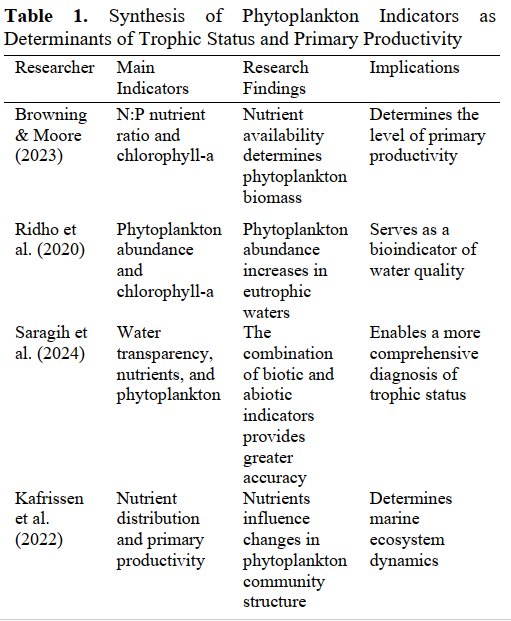
Phytoplankton are fundamental components of marine ecosystems because they function as primary producers and sensitive ecological indicators of environmental change. This study aimed to analyze the role of phytoplankton as indicators of trophic status and primary productivity in marine waters through a literature synthesis approach. The research employed a literature review method using a narrative-systematic review design based on PRISMA guidelines by analyzing 78 international scientific articles published between 2009 and 2024 from Scopus, Web of Science, and Google Scholar databases. Data were analyzed using thematic synthesis to identify relationships among phytoplankton community structure, trophic conditions, and primary productivity. The results showed that phytoplankton abundance, chlorophyll-a concentration, biomass, and taxonomic composition were strongly influenced by nutrient dynamics, temperature, water column stratification, and oceanographic processes such as upwelling. Dinoflagellates and cyanobacteria tended to dominate under eutrophic conditions, whereas small-sized phytoplankton were more prevalent in oligotrophic waters. In conclusion, phytoplankton are effective bioindicators for assessing trophic status and marine primary productivity. These findings highlight the importance of integrating biological and oceanographic parameters in marine ecosystem monitoring to support sustainable coastal management.
Keywords:
chlorophyll-a eutrophication phytoplankton primary productivityReferences
Brandt, P., Alory, G., Awo, F. M., Dengler, M., Djakouré, S., Imbol Koungue, R. A., Jouanno, J., Körner, M., Roch, M., & Rouault, M. (2023). Physical processes and biological productivity in the upwelling regions of the tropical Atlantic. Ocean Science, 19(3), 581–601. https://doi.org/10.5194/os-19-581-2023
Brewin, R. J. W., Sathyendranath, S., Platt, T., Bouman, H., Ciavatta, S., Dall’Olmo, G., Dingle, J., Groom, S., Jönsson, B., Kostadinov, T. S., Kulk, G., Laine, M., Martínez-Vicente, V., Psarra, S., Raitsos, D. E., Richardson, K., Rio, M.-H., Rousseaux, C. S., Salisbury, J., … Walker, P. (2021). Sensing the ocean biological carbon pump from space: A review of capabilities, concepts, research gaps and future developments. Earth-Science Reviews, 217, 103604. https://doi.org/10.1016/j.earscirev.2021.103604
Browning, T. J., & Moore, C. M. (2023). Global analysis of ocean phytoplankton nutrient limitation reveals high prevalence of co-limitation. Nature Communications, 14(1), 5014. https://doi.org/10.1038/s41467-023-40774-0
Chen, Z., Sun, J., Gu, T., Zhang, G., & Wei, Y. (2021). Nutrient ratios driven by vertical stratification regulate phytoplankton community structure in the oligotrophic western Pacific Ocean. Ocean Science, 17(6), 1775–1789. https://doi.org/10.5194/os-17-1775-2021
Dokulil, M. T., & Qian, K. (2021). Photosynthesis, carbon acquisition and primary productivity of phytoplankton: a review dedicated to Colin Reynolds. Hydrobiologia, 848(1), 77–94. https://doi.org/10.1007/s10750-020-04321-y
Glibert, P. M. (2020). Harmful algae at the complex nexus of eutrophication and climate change. Harmful Algae, 91, 101583. https://doi.org/10.1016/j.hal.2019.03.001
Gregg, W. W., & Rousseaux, C. S. (2019). Global ocean primary production trends in the modern ocean color satellite record (1998–2015). Environmental Research Letters, 14(12), 124011. https://doi.org/10.1088/1748-9326/ab4667
Henson, S. A., Cael, B. B., Allen, S. R., & Dutkiewicz, S. (2021). Future phytoplankton diversity in a changing climate. Nature Communications, 12(1), 5372. https://doi.org/10.1038/s41467-021-25699-w
Kitchenham, B., & Charters, S. (2007). Guidelines for performing systematic literature reviews in software engineering. Technical Report, Ver. 2.3 EBSE Technical Report. EBSE, January 2007, 1–57.
Kolluru, S., & Tiwari, S. P. (2022). Modeling ocean surface chlorophyll-a concentration from ocean color remote sensing reflectance in global waters using machine learning. Science of The Total Environment, 844, 157191. https://doi.org/10.1016/j.scitotenv.2022.157191
Lee, Z., & Marra, J. F. (2022). The Use of VGPM to Estimate Oceanic Primary Production: A “Tango” Difficult to Dance. Journal of Remote Sensing, 2022. https://doi.org/10.34133/2022/9851013
Naik, S., Mishra, R. K., Sahu, K. C., Lotliker, A. A., Panda, U. S., & Mishra, P. (2020). Monsoonal Influence and Variability of Water Quality, Phytoplankton Biomass in the Tropical Coastal Waters – A Multivariate Statistical Approach. Frontiers in Marine Science, 7. https://doi.org/10.3389/fmars.2020.00648
Page, M. J., McKenzie, J. E., Bossuyt, P. M., Boutron, I., Hoffmann, T. C., Mulrow, C. D., Shamseer, L., Tetzlaff, J. M., Akl, E. A., Brennan, S. E., Chou, R., Glanville, J., Grimshaw, J. M., Hróbjartsson, A., Lalu, M. M., Li, T., Loder, E. W., Mayo-Wilson, E., McDonald, S., … Moher, D. (2021). The PRISMA 2020 statement: an updated guideline for reporting systematic reviews. BMJ, n71. https://doi.org/10.1136/bmj.n71
Pierella Karlusich, J. J., Ibarbalz, F. M., & Bowler, C. (2020). Phytoplankton in the Tara Ocean. Annual Review of Marine Science, 12(1), 233–265. https://doi.org/10.1146/annurev-marine-010419-010706
Ridho, M. R., Patriono, E., & Mulyani, Y. S. (2020). Hubungan Kelimpahan Fitoplankton, Konsentrasi Klorofil-A Dan Kualitas Perairan Pesisir Sungsang, Sumatera Selatan. Jurnal Ilmu Dan Teknologi Kelautan Tropis, 12(1), 1–8. https://doi.org/10.29244/jitkt.v12i1.25745
Rosadi, R., Musa, M., & Djoko Lelono, T. (2020). Plankton Community Structure as Bioindicator Trophic Status of Jatigede Reservoir Waters. Research Journal of Life Science, 7(1), 29–40. https://doi.org/10.21776/ub.rjls.2020.007.01.4
Samawi, M. F., Tahir, A., Tambaru, R., Amri, K., Lanuru, M., & Armi, N. K. (2020). Phytoplankton and Physics Chemical Parameters in Estuary Waters, West Coast of South Sulawesi, Indonesia. Torani Journal of Fisheries and Marine Science, 61–70. https://doi.org/10.35911/torani.v3i2.11370
Saragih, F. S., Djamil, H., Juanda, J., Mubarak, A. S., Hasan, V., Sihombing, A., & Satyantini, W. H. (2024). Nutrient Concentration, Water Brightness, Chlorophyll-a, and Phytoplankton Abundance as Indicators for Determining the Trophic Status of Lake Toba, North Sumatera - Indonesia. Journal of Aquaculture and Fish Health, 13(3), 366–374. https://doi.org/10.20473/jafh.v13i3.57981
Snyder, H. (2019). Literature review as a research methodology: An overview and guidelines. Journal of Business Research, 104, 333–339. https://doi.org/10.1016/j.jbusres.2019.07.039
Su, H., Lu, X., Chen, Z., Zhang, H., Lu, W., & Wu, W. (2021). Estimating Coastal Chlorophyll-A Concentration from Time-Series OLCI Data Based on Machine Learning. Remote Sensing, 13(4), 576. https://doi.org/10.3390/rs13040576
Thomas, J., & Harden, A. (2008). Methods for the thematic synthesis of qualitative research in systematic reviews. BMC Medical Research Methodology, 8(1), 45. https://doi.org/10.1186/1471-2288-8-45
Tilstone, G. H., Pardo, S., Dall’Olmo, G., Brewin, R. J. W., Nencioli, F., Dessailly, D., Kwiatkowska, E., Casal, T., & Donlon, C. (2021). Performance of Ocean Colour Chlorophyll a algorithms for Sentinel-3 OLCI, MODIS-Aqua and Suomi-VIIRS in open-ocean waters of the Atlantic. Remote Sensing of Environment, 260, 112444. https://doi.org/10.1016/j.rse.2021.112444
Tranfield, D., Denyer, D., & Smart, P. (2003). Towards a Methodology for Developing Evidence‐Informed Management Knowledge by Means of Systematic Review. British Journal of Management, 14(3), 207–222. https://doi.org/10.1111/1467-8551.00375
Tsikoti, C., & Genitsaris, S. (2021). Review of Harmful Algal Blooms in the Coastal Mediterranean Sea, with a Focus on Greek Waters. Diversity, 13(8), 396. https://doi.org/10.3390/d13080396
West, J. J., Järnberg, L., Berdalet, E., & Cusack, C. (2021). Understanding and Managing Harmful Algal Bloom Risks in a Changing Climate: Lessons From the European CoCliME Project. Frontiers in Climate, 3. https://doi.org/10.3389/fclim.2021.636723
Wu, X., Liu, H., Ru, Z., Tu, G., Xing, L., & Ding, Y. (2021). Meta-analysis of the response of marine phytoplankton to nutrient addition and seawater warming. Marine Environmental Research, 168, 105294. https://doi.org/10.1016/j.marenvres.2021.105294
Yu, S., Bai, Y., He, X., Gong, F., & Li, T. (2023). A new merged dataset of global ocean chlorophyll-a concentration for better trend detection. Frontiers in Marine Science, 10. https://doi.org/10.3389/fmars.2023.1051619
Zhang, Y., Beardall, J., & Gao, K. (2025). Combined effects of ocean acidification and warming on phytoplankton productivity and community structure in the coastal water of Southern East. Marine Environmental Research, 210, 107352. https://doi.org/10.1016/j.marenvres.2025.107352