



About the Journal

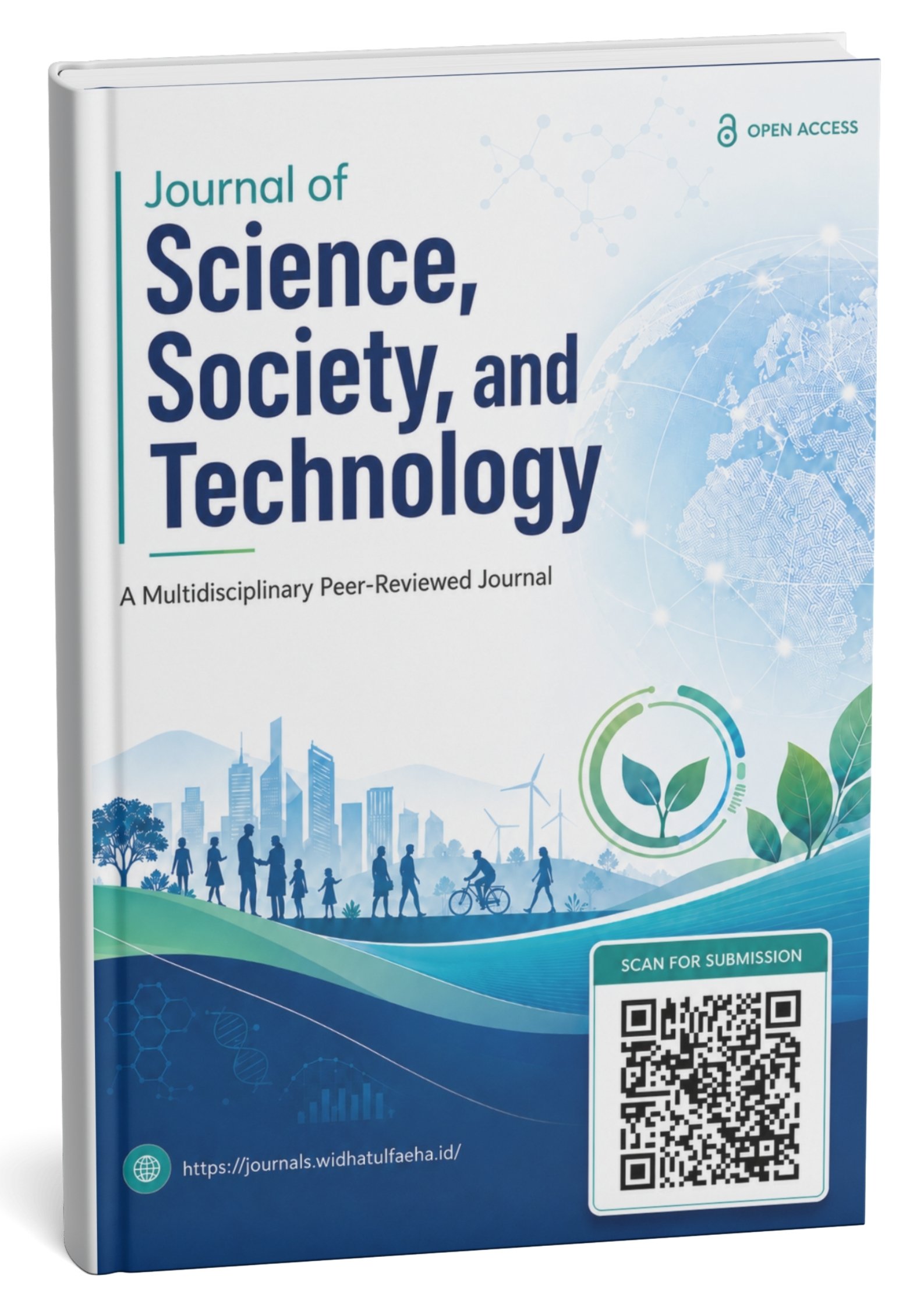
Journal title : Journal of Science, Society, and Technology
Initials : JSST
Editor-in-chief : Muhammad Al' Awali Salahuddin, S.Si., M.Si  
Online ISSN :  XXXX-XXXX  
DOI Prefix : 10.65622/jsst
Indexing : Google Scholar and view more  
Peer Review Process : blind-Review 
Frequency : Three  time (Febuary, June, Septe,mber)
Publisher : Yayasan Siti Widhatul Faeha  
Citation Analysis : Dimensions, Google Scholar
Language : English and Indonesia

Focus and Scope

Journal of Science, Society, and Technology is a peer-reviewed multidisciplinary journal that publishes high-quality scientific articles in the fields of natural sciences, applied sciences, social sciences, education, technology, environment, and community development. The journal aims to provide an academic platform for researchers, lecturers, practitioners, and policymakers to disseminate research findings that contribute to scientific advancement, social improvement, technological innovation, and sustainable development.

The journal focuses on the integration of science, society, and technology in addressing contemporary issues at local, national, regional, and global levels. It welcomes empirical studies, theoretical papers, applied research, review articles, and case studies that offer scientific novelty, methodological rigor, and practical relevance.

Scope of the Journal

The journal publishes articles in, but is not limited to, the following areas:

  1. Natural Sciences and Applied Sciences
    Biology, chemistry, physics, environmental science, marine science, agricultural science, biodiversity, conservation, ecology, biotechnology, and health-related sciences.
  2. Social Sciences and Humanities
    Sociology, anthropology, public policy, community development, communication studies, economics, cultural studies, social welfare, governance, and human development.
  3. Education and Learning Innovation
    Science education, social science education, curriculum development, learning media, educational technology, teaching methods, assessment, and classroom-based research.
  4. Technology and Innovation
    Information technology, digital transformation, artificial intelligence, data science, engineering, applied technology, technological innovation, digital society, and technology for community empowerment.
  5. Environment and Sustainable Development
    Environmental management, climate change, disaster risk reduction, sustainable development, conservation, ecotourism, renewable energy, waste management, and natural resource management.
  6. Science, Society, and Policy Interface
    Studies that connect scientific knowledge with social needs, public policy, community participation, local wisdom, technology adoption, and evidence-based decision-making.