Research Trends in Creative Thinking Skills in Students' Physics Learning: A Bibliometrics Analysis
Published:
2026-02-28 — Updated on 2026-04-07Versions:
- 2026-04-07 (2)
- 2026-02-28 (1)
Downloads
Abstract
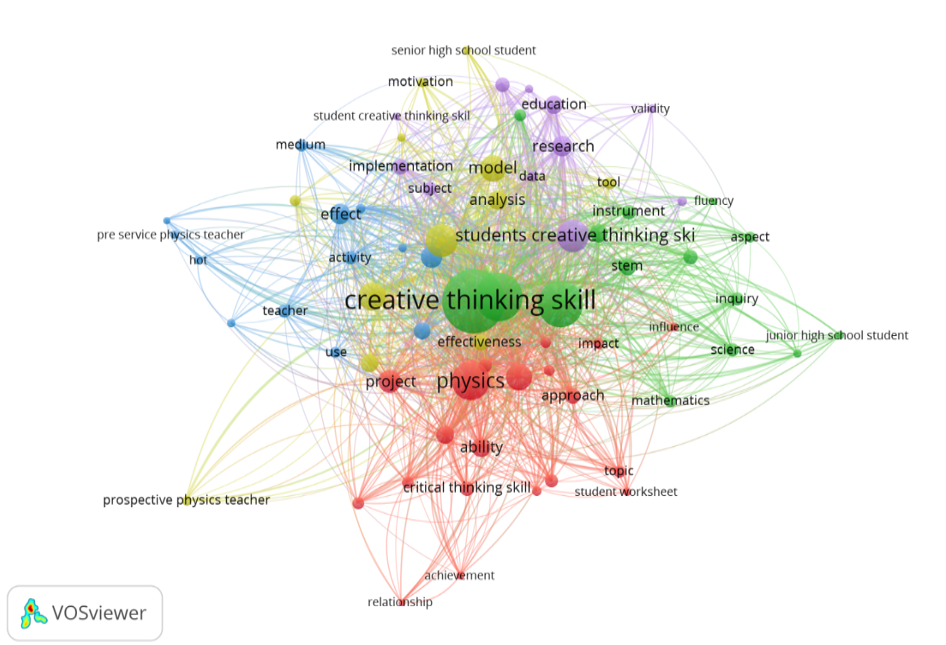
In the era of rapid technological advancement and increasing educational demands, the development of creative thinking skills in students’ physics learning has become a critical focus to enhance higher-order thinking competencies and learning effectiveness. This study discusses research trends on creative thinking skills in physics learning from 2015 to 2024. The research method used is descriptive and analytical using data from Google Scholar. The results of the analysis show fluctuations in the increase in the number of publications during this period, with a decrease in 2019 and 2022 before increasing again in 2023. Key words that often appear in this research include creative thinking skills, physics teacher, PBL, and science learning. These findings make a significant contribution to 21st century education, emphasizing the importance of creative thinking skills in students' understanding of scientific concepts. This research shows that the development of new learning models can facilitate students' creative thinking skills in physics learning. Thus, this research provides insight into research trends that continue to develop and are relevant for improving the quality of education in the future.
Keywords:
Creative Thinking Skill Physics Learning overviewReferences
Alhafizin, M., Supratman, S., Asri, M., & Shelvyandira, I. L. (2025). The Impact of Problem-Based Learning on The Biology Achievement of Grade XI Students at SMAN 1 Sikur, East Lombok. Indonesian Journal of Educational Innovation, 1(2), 37–41. Retrieved from https://journals.widhatulfaeha.id/index.php/jpkjl/article/view/62
Badmus, O. T., & Jita, L. C. (2024). Physics difficulty and problem-solving: Exploring the role of mathematics and mathematical symbols. Interdisciplinary Journal of Education Research, 6, 1-14. https://doi.org/10.38140/ijer-2024.vol6.08
Bahtiar, B., Yusuf, Y., Doyan, A., & Ibrahim, I. (2023). The Trend of Technology Pedagogical Content Knowledge (TPACK) Research in 2012-2022: Contribution to Science Learning of 21st Century. Jurnal Penelitian Pendidikan IPA, 9(5), 39-47. 10.29303/jppipa.v9i5.3685
Beetlestone, F. 2011. Creative Children, Imaginative Teaching. Strategi Pembelajaran untuk Melesatkan Kreativitas Siswa diterjemahkan oleh Narulita Yusron. Bandung: Nusa Media
Dani, K. G., Saputro, E. F. H., & Lestari, N. (2022). Penerapan Media Pembelajaran Interaktif untuk Meningkatkan Keterampilan Berpikir Kreatif Siswa. QUANTUM: Jurnal Pembelajaran IPA dan Aplikasinya, 2(2), 37-41.
Doyan, A., Susilawati, S., Hadisaputra, S., & Muliyadi, L. (2022). Effectiveness of quantum physics learning tools using blended learning models to improve critical thinking and generic science skills of students. Jurnal Penelitian Pendidikan IPA, 8(2), 1030-1033.10.29303/jppipa.v8i2.1625
Good, M., Maries, A., & Singh, C. (2019). Impact of traditional or evidence-based active-engagement instruction on introductory female and male students’ attitudes and approaches to physics problem solving. Physical Review Physics Education Research, 15(2), 020129. https://doi.org/10.1103/PhysRevPhysEducRes.15.020129
Hallinger, P., & Chatpinyakoop, C. (2019). Tinjauan Bibliometrik Penelitian Pendidikan Tinggi untuk Pembangunan Berkelanjutan, 1998–2018. Keberlanjutan, 11 (8), 2401. https://doi.org/10.3390/su11082401
Hallinger, P., & Nguyen, V.-T. (2020). Memetakan Lanskap dan Struktur Penelitian Pendidikan untuk Pembangunan Berkelanjutan: Tinjauan Bibliometrik. Keberlanjutan, 12 (5), 1947. https://doi.org/10.3390/su12051947
Hidayatullah, M. I., Udayani, N. W. A., & Hamdiana. (2025). A Project-Based Learning Model Design for Social Studies to Develop 21st-Century Skills in Primary School Students. Jurnal Literasi Pendidikan Indonesia, 1(1), 27–35. Retrieved from https://journals.widhatulfaeha.id/index.php/jper/article/view/87
Hiidayatullah, N., & Fatimah, Z. (2025). The Effectiveness of the Problem-Based Learning Model on the Critical Thinking Skills of Grade XI Students at MAN 1 Central Lombok. Indonesian Journal of Educational Innovation, 1(3), 21–27. https://doi.org/10.65622/ijei.v1i3.156
Hulwani, A. Z., Pujiastuti, H., & Rafianti, I. (2021). Pengembangan Media Pembelajaran Interaktif Android Matematika dengan Pendekatan STEM pada Materi Trigonometri. Jurnal Cendekia : Jurnal Pendidikan Matematika, 5(3), 2255–2269. https://doi.org/10.31004/cendekia. v5i3.717
Ishlahul'Adiilah, I., & Haryanti, Y. D. (2023). Pengaruh model problem based learning terhadap kemampuan berpikir kreatif siswa pada pembelajaran IPA. Papanda Journal of Mathematics and Science Research, 2(1), 49-56. https://doi.org/10.56916/pjmsr.v2i1.306
Kwangmuang, P., Jarutkamolpong, S., Sangboonraung, W., & Daungtod, S. (2021). The development of learning innovation to enhance higher order thinking skills for students in Thailand junior high schools. Heliyon, 7(6). https://doi.org/10.1016/j.heliyon.2021.e07309
Munfaridah, N., Avraamidou, L., & Goedhart, M. (2021). The use of multiple representations in undergraduate physics education: what do we know and where do we go from here?. Eurasia Journal of Mathematics, Science and Technology Education, 17(1), em1934. https://doi.org/10.29333/ejmste/9577
Setiawan, A., Malik, A., Suhandi, A., & Permanasari, A. (2018, February). Effect of higher order thinking laboratory on the improvement of critical and creative thinking skills. In IOP Conference Series: Materials Science and Engineering (Vol. 306, No. 1, p. 012008). IOP Publishing. https://doi.org/10.1088/1757-899X/306/1/012008
Tricco, A. C., Lillie, E., Zarin, W., O'Brien, K. K., Colquhoun, H., Levac, D., ... & Straus, S. E. (2018). PRISMA extension for scoping reviews (PRISMA-ScR): checklist and explanation. Annals of internal medicine, 169(7), 467-473. https://doi.org/10.7326/M18-0850
Yan, L., & Zhiping, W. (2023). Mapping the literature on academic publishing: A bibliometric analysis on WOS. Sage Open, 13(1), 21582440231158562. https://doi.org/10.1177/21582440231158562