The Effectiveness of the Project-Based Learning Model to Enhance High School Students’ Problem-Solving Skills in the City of Mataram, West Nusa Tenggara
DOI:
10.65622/ijei.v1i3.153Downloads
Abstract
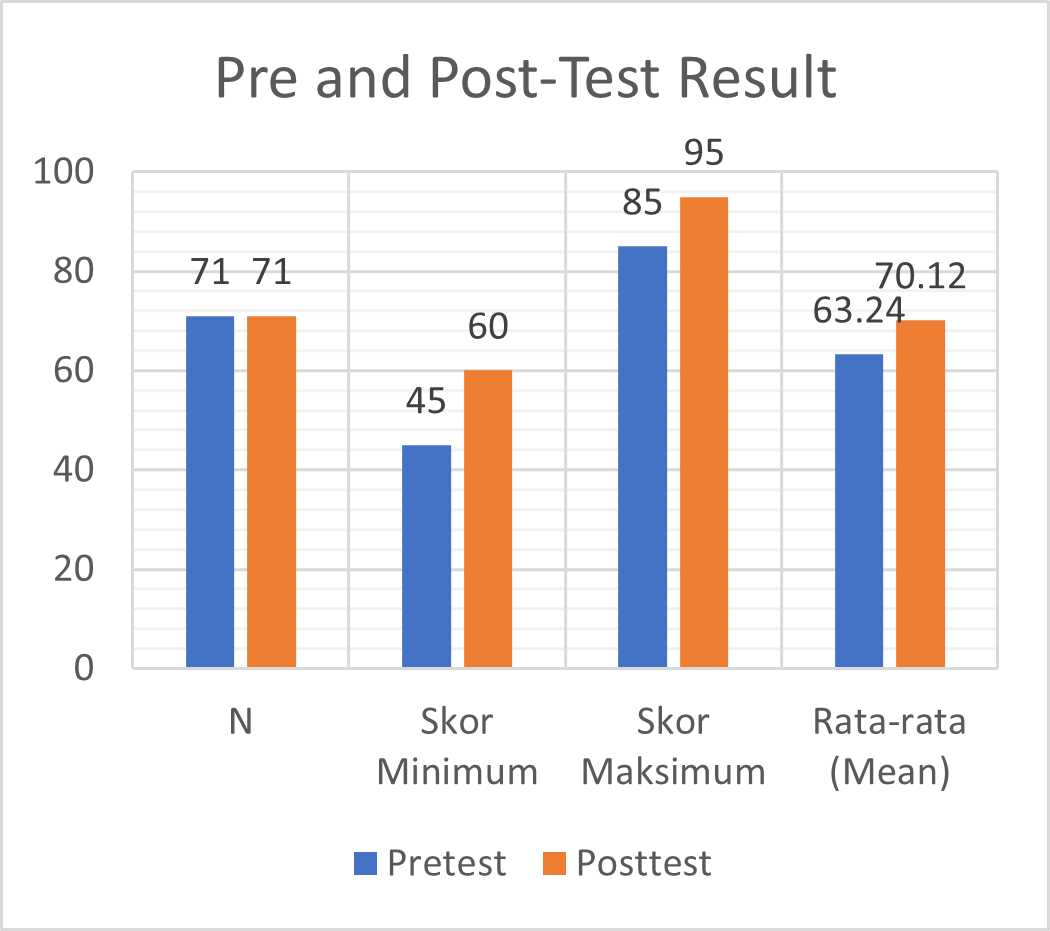
21st-century physics learning requires problem-solving skills, but school practices often remain teacher-centered and formula-oriented. This study aims to analyze the effect of implementing a project-based learning model on 11th-grade students’ problem-solving skills in linear motion at SMA Negeri 2 Mataram. The research used a one-group pretest-posttest design with a purposively selected sample of 71 students. The results indicated strong validity (17 of 20 items were valid) and high reliability (KR-20 = 0.854). The average score went up from 63.24 on the pretest to 70.12 on the posttest. Normality testing confirmed that the data were normally distributed, and the paired sample t-test showed a significant difference (t-value of 5.527 exceeded the t-table value of 2.000). These findings confirm that project-based learning is efficacious in improving students’ problem-solving skills. The PjBL model is effective in developing these skills and can serve as an innovative learning strategy to enhance physics learning in secondary schools.
Keywords:
Project-Based Learning 21st Century Learning Model Student Centred Learning Learning Innovation Problem-Solving SkillsReferences
Ahmida, N. Y. A. (2025). Efektivitas model pembelajaran project based learning berbantuan glide apps terhadap kemampuan pemecahan masalah matematis siswa (Doctoral dissertation, Universitas Islam Sultan Agung Semarang). https://repository.unissula.ac.id/40844/2/Pendidikan%20Matematika_34202100008_fullpdf.pdf.
AlAli, R. (2024). Enhancing 21st century skills through integrated STEM education using project-oriented problem-based learning. Geo Journal of Tourism and Geosites, 53(2), 421-430. https://doi.org.10.30892/gtg.53205-1217
Almulla, M. A. (2020). The effectiveness of the project-based learning (PBL) approach as a way to engage students in learning. Sage Open, 10(3), 2158244020938702. https://doi.org/10.1177/2158244020938702.
Andriyatno, I., Purwianingsih, W., Solihat, R., Nurazizah, W. E., & Levhan, K. W. A. L. (2024). Project-Based Learning (PjBL) Contains Sustainable Development Goals (SDGs): Students’ Metacognitive Awareness Improvement Efforts. EDUSAINS, 16(2), 167-181. https://doi.org/10.15408/es.v16i2.37868.
Arifa, A. B., Wibawanto, S., & Wirawan, I. M. (2018). Penerapan model pembelajaran project based learning dengan strategi metakognitif untuk meningkatkan metakognitif dan hasil belajar. Jurnal Ilmiah Teknologi Infomasi Terapan, 4(3). https://doi.org/10.33197/jitter.vol4.iss3.2018.173.
Aziz, S. A., & Nurachadijat, K. (2023). Project based learning dalam meningkatkan keterampilan belajar siswa. Jurnal Inovasi, Evaluasi Dan Pengembangan Pembelajaran (JIEPP), 3(2), 67-74. https://journal.ainarapress.org/index.php/jiepp/article/download/273/302.
Deci, E. L., & Ryan, R. M. (2013). Intrinsic motivation and self-determination in human behavior. Springer Science & Business Media.
Dewi, D., Mukaromah, A., Ilham, M., & Arifin, Z. (2025). The Effectiveness of Project-Based Learning in Improving Students’ Critical Thinking Skills. Journal of English Language and Education, 10(4), 1139-1145. https://doi.org/10.31004/jele.v10i4.1292.
Granado-Alcón, M. D. C., Gómez-Baya, D., Herrera-Gutiérrez, E., Vélez-Toral, M., Alonso-Martín, P., & Martínez-Frutos, M. T. (2020). Project-based learning and the acquisition of competencies and knowledge transfer in higher education. Sustainability, 12(23), 10062. https://www.mdpi.com/2071-1050/12/23/10062#
Guilford, J. P. (1956). Fundamental statistics in psychology and education (3rd ed.). McGraw-Hill.
Guo, P., Saab, N., Post, L. S., & Admiraal, W. (2020). A review of project-based learning in higher education: Student outcomes and measures. International journal of educational research, 102, 101586. https://doi.org/10.1016/j.ijer.2020.101586.
Hidayat, M. R. (2022). Peningkatan kreatifitas pembelajaran Bahasa Indonesia Siswa Tingkat Dasar Melalui Project Learning Berbasis Merdeka Belajar. EUNOIA (Jurnal Pendidikan Bahasa Indonesia), 2(2), 90-102. https://jurnaltarbiyah.uinsu.ac.id/index.php/eunoia/article/download/2069/983.
Hidayatullah, M. I., & Udayani, N. W. A. (2025). A Project-Based Learning Model Design for Social Studies to Develop 21st-Century Skills in Primary School Students. Jurnal Literasi Pendidikan Indonesia, 1(1), 27-35. https://journals.widhatulfaeha.id/index.php/jper/article/download/87/34.
Hidayatullah, M. I., & Widhyastuti, K. L. (2025). Tinjauan Literatur: Efektifitas Penggunaan Model Pembelajaran Inquiry dalam Pembelajaran IPA di Sekolah Dasar. Indonesian Journal on Education (IJoEd), 1(3), 228-234. https://ijoed.org/index.php/ijoed/article/download/112/73.
Hmelo-Silver, C. E. (2004). Problem-based learning: What and how do students learn? Educational Psychology Review, 16(3), 235–266. https://doi.org/10.1023/B:EDPR.0000034022.16470.f3.
Jalinus, N., Syahril, S., & Nabawi, R. A. (2019). A comparison of the problem-solving skills of students in PjBL versus CPjBL model: An experimental study. Journal of Technical Education and Training, 11(1). https://publisher.uthm.edu.my/ojs/index.php/JTET/article/view/3154
Kokotsaki, D., Menzies, V., & Wiggins, A. (2016). Project-based learning: A review of the literature. Improving schools, 19(3), 267-277. https://doi.org/10.1177/1365480216659733
Kurniahtunnisa, K., Anggraito, Y. U., Ridlo, S., & Harahap, F. (2023). STEM-PjBL learning: the impacts on Students’ critical thinking, creative thinking, communication, and collaboration Skills. Jurnal Penelitian Pendidikan IPA, 9(7), 5007-5015. https://doi.org/10.29303/jppipa.v9i7.2985
Loyens, S. M., Van Meerten, J. E., Schaap, L., & Wijnia, L. (2023). Situating higher-order, critical, and critical-analytic thinking in problem-and project-based learning environments: A systematic review. Educational Psychology Review, 35(2), 39. https://doi.org/10.1007/s10648-023-09757-x
Murniarti, E. (2021). Penerapan metode project based learning dalam pembelajaran. Journal of Education, 3(1), 1-18. http://ap.fip.um.ac.id/wp-content/uploads/2016/03/28-Erni-Murniarti.pdf.
Nadawina, N., Jaya, A., Ramadhanti, D., Imronudin, I., Fatchiatuzahro, F., Halim, A., & Jati, G. P. R. S. (2025). Penerapan Pembelajaran Deep Learning dalam Pendidikan di Indonesia. Star Digital Publishing.
Omelianenko, O., & Artyukhova, N. (2024). Project-based learning: Theoretical overview and practical implications for local innovation-based development. Economics and Education, 9(1), 35-41. http://www.baltijapublishing.lv/index.php/econedu/article/download/2373/2370
Piaget, J. (2008). Intellectual evolution from adolescence to adulthood. Human development, 51(1), 40-47. https://search.proquest.com/openview/d06aad669ef4ec48974110350ee2122e/1?pq-origsite=gscholar&cbl=41080.
Rahman, M. H. (2025). Analysis of the Teacher's Role as a Facilitator in Project-Based Learning to Enhance Student Creativity. The Journal of Academic Science, 2(8), 1952-1960. https://doi.org/10.59613/y98ctm25
Rasyidi, A. (2024). Optimalisasi Pembelajaran PAI: Strategi Pembelajaran Berbasis Proyek untuk Meningkatkan Keterampilan Siswa di Sekolah. Universal Explorations In Research, 1(1), 16-35.
Sah, F., Sasikirana, H. N., & Pujiani, T. (2024). The implementation of project-based learning in developing 21st century skills in EFL class. Jadila: Journal of Development and Innovation in Language and Literature Education, 4(4), 257-272. https://jadila.yayasancec.or.id/index.php/jadila/article/download/797/681.
Santosa, P. (2018). Mahir Praktikum Biologi, Penggunaan Alat-Alat Sederhana dan Murah Untuk Percobaan Biologi. Deepublish.
Situmorang, M., Sinaga, M., Sitorus, M., & Sudrajat, A. (2022). Implementation of project-based learning innovation to develop students’ critical thinking skills as a strategy to achieve analytical chemistry competencies. chemistry, 15, 16. https://archives.ijper.org/sites/default/files/IndJPhaEdRes-56-1s-41_0.pdf
Susanta, A., & Susanto, E. (2020). Efektivitas project based learning terhadap kemampuan pemecahan masalah dan berpikir kritis mahasiswa. Jurnal Theorems, 5(1), 61-68. https://doi.org/10.31949/th.v5i1.2219.
Syafila, A. E., & A'yun, D. Q. (2024). Analisis eksplorasi konsep pendidikan konstruktivis dalam pembelajaran berbasis proyek. Jurnal Media Akademik (JMA), 2(12).
Vygotsky, L. S. (1978). Mind in society: The development of higher psychological processes (M. Cole, V. John-Steiner, S. Scribner, & E. Souberman, Eds.). Harvard University Press.
Wijnia, L., Noordzij, G., Arends, L. R., Rikers, R. M., & Loyens, S. M. (2024). The effects of problem-based, project-based, and case-based learning on students’ motivation: A meta-analysis. Educational Psychology Review, 36(1), 29. https://doi.org/10.1007/s10648-024-09864-3.
Williamson, E. (2023). The effectiveness of project-based learning in developing critical thinking skills among high school students. European Journal of Education, 1(1), 1-11. https://forthworthjournals.org/journals/index.php/EJE/article/download/26/23
Wulandari, M. A., Senen, A., Wardani, D. S., & Ruqoyyah, S. (2025). Transforming Education Through Project-Based Learning (PjBL): Enhancing Students' Learning Outcomes and Critical Thinking. Jurnal Profesi Pendidikan, 4(1), 200-215. https://doi.org/10.22460/jpp.v4i1.27655
Yang, X. (2023). A historical review of collaborative learning and cooperative learning. TechTrends, 67(4), 718–728. https://doi.org/10.1007/s11528-022-00823-9.
Zulyusri, Z., Elfira, I., Lufri, L., & Santosa, T. A. (2023). Literature study: Utilization of the PjBL model in science education to improve creativity and critical thinking skills. Jurnal Penelitian Pendidikan IPA, 9(1), 133-143. https://doi.org/10.29303/jppipa.v9i1.2555