The Effect of The Project-Based Learning Model on High School Students' Science Process Skills
DOI:
10.65622/ijei.v1i3.155Downloads
Abstract
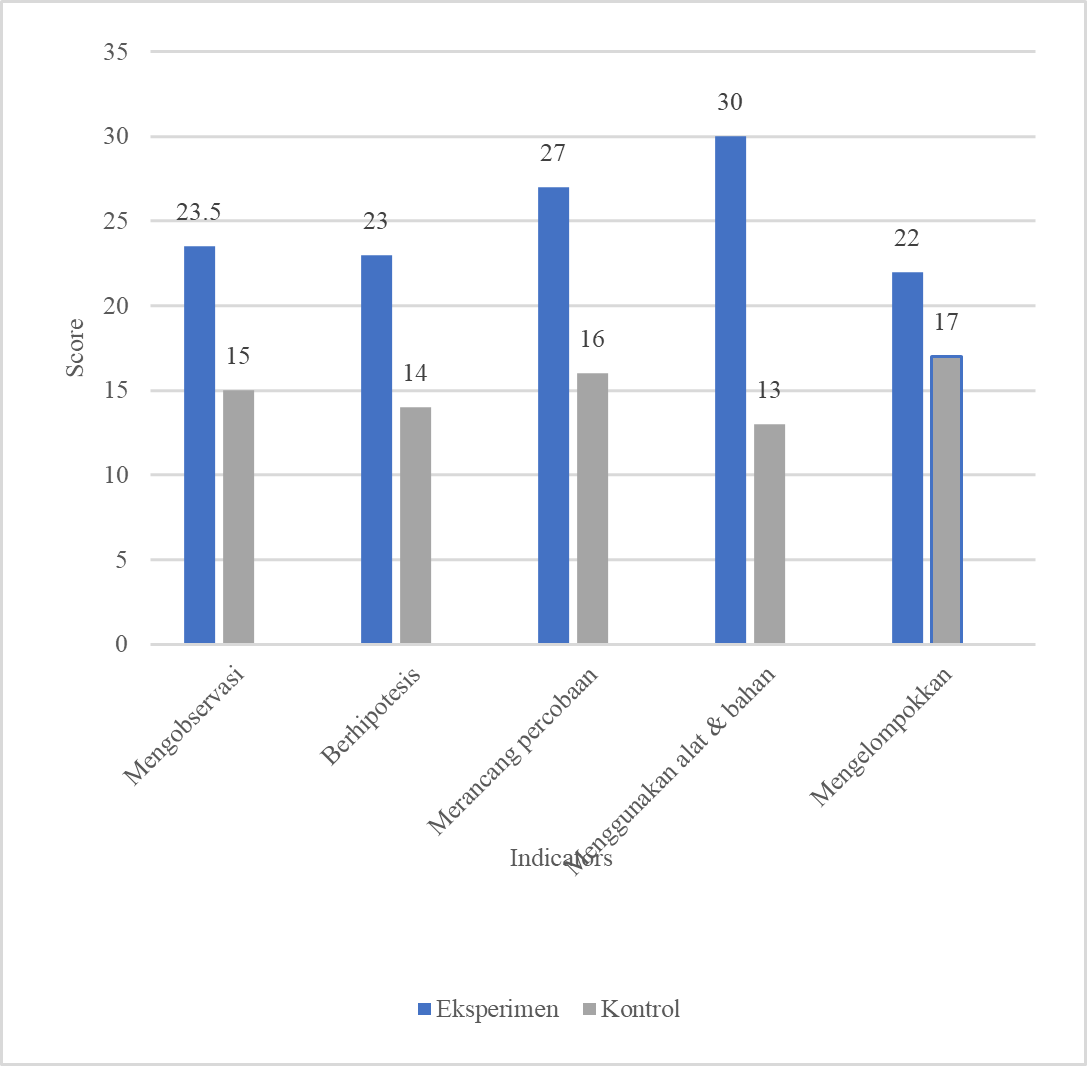
Project-Based Learning is an instructional strategy that improves students' Science Process Skills (SPS) by involving them in hands-on scientific project design and implementation. This study investigates the effect of PjBL on students’ SPS, focusing on skills such as observing, generating hypotheses, planning experiments, using tools and materials, collaborating in groups, and communicating scientifically. The research follows a quasi-experimental design with a pretest-posttest control group, including two XI classes at SMAN 1 Lembar, selected through purposive sampling. One class (XI-1) is assigned to the experimental group, which uses PjBL, while the other (XI-2) is the control group, which follows traditional teaching methods. The study uses a science process skills test as the research instrument. The N-Gain analysis showed a moderate improvement of 0.335 in the experimental group, compared to a minimal improvement of 0.011 in the control group. A t-test (t = 6.84 > t = 1.673 at the 5% significance level) confirmed the significant effect of PjBL. The results indicate that PjBL effectively enhances students’ scientific skills, critical thinking, and creativity, making it a viable and innovative approach for science education. These results suggest that PjBL can be foundational to developing more integrated, context-driven approaches to science learning.
Keywords:
Project-Based Learning Science Process Skills science learningReferences
Almulhim, F. A., Alnagar, D. K., Mohamed, E. I., & Hassan, N. M. (2025). Dependent and Independent Sampling Techniques for Modeling Radiation and Failure Data. Journal of Radiation Research and Applied Sciences, 14(3), 1–14. https://doi.org/10.1016/j.jrras.2025.101377
Barut, M., & Yüce, Z. (2025). Investigation of The Relationship between The Scientific Process Skills, Self-regulation Skills, and Academic Achievement of Middle School Students in Science. World Journal of Education, 15(1), 78–90. https://doi.org/10.5430/wje.v15n1p78
Basaga, H., Geban, Ö., & Tekkaya, C. (1994). The Effect of The Inquiry Teaching Method on. Biochemistry and Science Process Skill Achievements. Biochemical Education, 22(1), 29–32. https://doi.org/10.1016/0307-4412(94)90136-8
Box, J. F. (1978). R. A. Fisher: The life of a scientist. New York: Wiley.
Campbell, D. T., & Stanley, J. C. (1963). Experimental and Quasi-Experimental Designs for Research. Wadsworth.
Cheerapakorn, P., Hinon, K., & Wannapiroon, P. (2024). Hybrid Project-Based Learning Model on Metaverse to Enhance Collaboration. International Education Studies, 17(6), 65–76. https://doi.org/10.5539/ies.v17n6p65
Ching YH, Yang D, Baek Y, Baldwin S. (2021). Project-Based Learning in Coding Education for Gifted Learners: Impacts on Engagement, Persistence, and Computational Thinking. Gifted Child Q, 65(3), 193-209. https://doi.org/10.1177/00169862211001553
Creswell, J. W. (2014). Research design: Qualitative, Quantitative, and Mixed Methods Approaches (4th ed.). Thousand Oaks, CA: SAGE Publications.
Dolapcioglu, S., & Subası, M. (2022). The Relationship between Scientific Process Skills and Science Achievement : A Meta-Analysis Study. Journal of Science Learning, 5(2), 363 372. https://doi.org/10.17509/jsl.v5i2.39356
Ekici, M., & Erdem, M. (2020). Developing science process skills through mobile scientific inquiry. Thinking Skills and Creativity, 36, 100658. https://doi.org/10.1016/j.tsc.2020.100658
Firda, N., Syamsuriwal, S., Gustina, G., & Jarnawi, M. (2024). Pengaruh Model Pembelajaran Berbasis Proyek (PjBL) terhadap Keterampilan Proses Sains Siswa pada Materi Pengukuran. JPFT (Jurnal Pendidikan Fisika Tadulako Online), 12(3), 178-184. https://doi.org/10.22487/jpft.v12i3.3754
Fraenkel, J. R., Wallen, N. E., & Hyun, H. H. (2012). How to Design and Evaluate ResearchiIn Education (8th Ed.). New York, NY: McGraw-Hill.
Golob, N., & Ungar, V. (2025). The Development of Science Process Skills and Content Knowledge with Inquiry Boxes in Early Childhood Education. Center for Educational Policy Studies Journal, 15(2), 249–279. https://doi.org/10.26529/cepsj.1631
Hake, R. R. (1998). Interactive-Engagement Versus Traditional Methods: a Six-Thousand-Student Survey of Mechanics Test Data for Introductory Physics Courses. American Journal of Physics, 66(1), 64–74. https://doi.org/10.1119/1.18809
Hamidah, N., Alamsyah, M. R. N., & Kusumaningrum, S. B. C. (2023). Pengaruh Model Pembelajaran Berbasis Proyek terhadap Keterampilan Proses Sains dan Motivasi Belajar Siswa SMA Negeri 1 Candimulyo pada Materi Perubahan Lingkungan. Jurnal Inovasi Pendidikan, 1(2), 129-142. https://doi.org/10.60132/jip.v1i2.37
Jagirani, M. S., Ozalp, O., & Soylak, M. (2022). New Trend in The Extraction of Pesticides from Environmental and Food Samples Applying Microextraction Based Green Chemistry Scenario: A Review. Critical Reviews in Analytical Chemistry, 52(6), 1343–1369. https://doi.org/10.1080/10408347.2021.1874867
Jeong, H. (2025). Supporting Interest Development in Gifted Software Education Through Computational Thinking and Project-Based Learning. Computers and Education Open, 9, 100282. https://doi.org/10.1016/j.caeo.2025.100282
Tobin, K. G., Kahle, J. B., & Fraser, B. J. (Eds.). (1990). Windows into science classrooms: Problems associated with Higher-Level Cognitive Learning. NewYork: Psychology Press.
Khamhaengpol, A., Nokaew, T., & Chuamchaitrakool, P. (2024). Development of STEAM Activity “Eco-Friendly Straw” Based Science Learning Kit to Examine Students’ Basic Science Process Skills. Thinking Skills and Creativity, 53, 101618. https://doi.org/10.1016/j.tsc.2024.101618
McLaughlin, C., Burns, D., & Scott, P. (2024). Evaluating The Impact of Project-Based Learning in Supporting Students with The A-Level Chemistry. Chemistry Education Research and Practice, 25(2), 317–330. https://doi.org/10.1021/acs.jchemed.3c01184
Mesnan, M., Manalu, N., & Supriadi, A. (2023). The Impact of Applying Scientific Learning with Conventional Learning on Creativity and Physical Education Learning Outcomes of High School Students. International Journal of Education in Mathematics, Science and Technology, 11(6), 1582–1596. https://doi.org/10.46328/ijemst.3688
Ozkan, G., & Umdu Topsakal, U. (2021). Analysis of Turkish Science Education Curricula's Learning Outcomes According to Science Process Skills. Mimbar Sekolah Dasar, 8(3), 295-306. https://doi.org/10.53400/mimbar-sd.v8i3.35746
Pedro, Z. M., Álvarez-Montero, A., Casas, J. A., & Muñoz, M. (2025). Active Learning in Environmental Engineering: Combining Interactive Platforms and Project-Based Approaches to Boost Engagement and Academic Performance. Education for Chemical Engineers, 53, 161-170. https://doi.org/10.1016/j.ece.2025.09.002
Phylactou, P., Papadatou-Pastou, M., & Konstantinou, N. (2025). The Bayesian One-sample t-test Supersedes Correlation Analysis as a Test of Validity. European Journal of Psychology Open, 84(1), 1–12. https://doi.org/10.1024/2673-8627/a000069
Pringle, T. A., & Knight, J. C. (2025). The Effects of Buffer, pH, and Temperature upon SPAAC Reaction Rates. Organic & Biomolecular Chemistry, 23(10), 2432-2438.
Roth, W.-M., & Roychoudhury, A. (1993). The Development of Science Process Skills in Authentic Contexts. Journal of Research in Science Teaching, 30(2), 127–152. https://doi.org/10.1002/TEA.3660300203
Shapiro, S. S., Wilk, M. B., & Chen, H. J. (1968). A Comparative Study of Various tests for Normality. Journal of the American Statistical Association, 63(324), 1343-1372.
Sideri, A., & Skoumios, M. (2021). Science Process Skills in the Greek Primary School Science Textbooks. Science Education International, 32(3), 231-236. https://doi.org/10.33828/sei.v32.i3.6
Sol´e-Llussa, ` A., Aguilar, D., & Ib´ anez, ˜ M. (2022). Video-worked Examples to Support the Development of Elementary Students’ Science Process Skills: A Case Study in an Inquiry Activity on Electrical Circuits. Research in Science & Technological Education, 40(2), 251–271. https://doi.org/10.1080/02635143.2020.178636
Cook, T. D., & Campbell, D. T. (1979). Quasi-Experimentation: Design and Analysis Issues for Field Settings. Boston, MA: Houghton Mifflin Company.
Tolcha, T., Gemechu, T., Al-Hamimi, S., Megersa, N., & Turner, C. (2020). High Density Supercritical Carbon Dioxide for The Extraction of Pesticide Residues in onion with Multivariate Response Surface Methodology. Molecules, 25(4), 1012. https://doi.org/10.3390/molecules25041012
Xie, Q., Jantharajit, N., & Srikhao, S. (2025). Enhancing Learning Efficiency and Critical Thinking Skills of Vocational Nursing Students: a Hybrid Instructional Approach Based on Cooperative Learning and Project-Based Learning. Journal of Education and Learning, 14(3), 85–96. https://doi.org/10.5539/jel.v14n3p85
Yalçınkaya-Önder, E., Zorluoğlu, S. L., Timur, B., Timur, S., Güvenç, E., Özergun, I., & Özdemir, M. (2022). Investigation of Science Textbooks in Terms of Science Process Skills. International Journal of Contemporary Educational Research, 9 (2), 432 -449. https://doi.org/10.33200/ijcer.1031338
Yang, H., Zhang, Q., & Shen, M. (2024). The Practice and Research of Junior High School Information Technology Project-Based Learning Based on STEM Education Concept. International Journal of Technology in Education and Science (IJTES), 8(1), 63-74. https://doi.org/10.46328/ijtes.537