Analysis of Creative Thinking Test Items in Problem-Based Learning Integrated with Ethnoscience
DOI:
10.65622/ijei.v1i3.158Downloads
Abstract
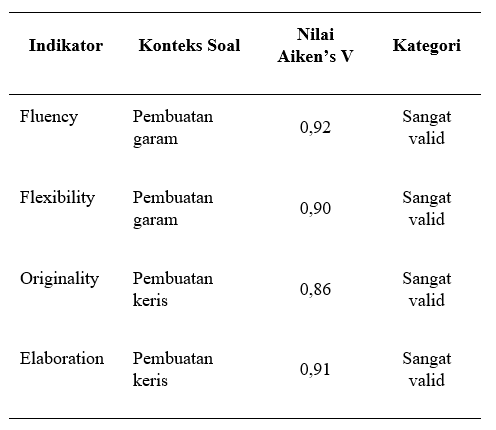
The need for culturally responsive science learning highlights the importance of assessment instruments that can capture students’ creative thinking skills. This study aims to analyze the validity and alignment of creative-thinking test items developed within a Problem-Based Learning (PBL) framework integrated with ethnoscience. The research used a Research and Development (R&D) design based on the ADDIE model, covering analysis, design, development, implementation, and evaluation. Essay-type questions were constructed to measure four indicators of creative thinking: fluency, flexibility, originality, and elaboration. Content validity was assessed by material and assessment experts using Aiken’s V. In contrast, qualitative descriptive techniques were used to examine the suitability of the items with creative-thinking indicators and ethnoscience contexts. The results show that all test items achieved very high content validity, with Aiken’s V values ranging from 0.86 to 0.92. Each creative-thinking indicator was represented proportionally, and all items were judged relevant to local cultural practices, particularly the salt-making process in Pejot Village and keris-making traditions in Sakra Village, East Lombok. The study concludes that the developed instrument is valid and feasible for assessing creative thinking skills in PBL-based science learning integrated with ethnoscience. These findings suggest that culturally grounded assessment instruments can enhance science education by fostering deeper, more creative student engagement with scientific concepts.
Keywords:
ADDIE model assessment instrument creative thinking skills ethnoscience problem-based learning science educationReferences
Aiken, L. R. (1985). Three coefficients for analyzing the reliability and validity of ratings. Educational and Psychological Measurement, 45(1), 131–142. https://doi.org/10.1177/0013164485451012
Alqahtani, T. M., Yusop, F. D., & Halili, S. H. (2023). Content validity of the Constructivist Learning in Higher Education Settings (CLHES) scale in the context of the flipped classroom in higher education. Humanities and Social Sciences Communications, 10(1), 1-12. https://doi.org/10.1057/s41599-023-01754-3
Alwadaeen, N. B., & Piller, B. (2022). Enhancing self-directed learning readiness at elementary level; a study from American schools. Journal of Curriculum and Teaching, 11(4), 24-38. https://doi.org/10.5430/jct.v11n4p24
Amini, J. N., Irwandi, D., & Bahriah, E. S. (2021). The effectiveness of problem based learning model based on ethnoscience on student’s critical thinking skills. JCER (Journal of Chemistry Education Research), 5(2), 77-87. https://doi.org/10.26740/jcer.v5n2.p77-87
Arifah, N., & Asikin, M. (2018). Kemampuan Berpikir Kreatif Matematis Dalam Setting Pembelajaran Creative Problem Solving Dengan Pendekatan Open-Ended (Sebuah Kajian Teoritik). In Seminar Nasional Pendidikan Matematika Ahmad Dahlan (Vol. 6).
Branch, R. M. (2009). Instructional Design: The ADDIE Approach. Springer.
Creswell, J. W. (2012). Educational Research: Planning, Conducting, and Evaluating Quantitative and Qualitative Research (4th ed.). Pearson Education, Inc. https://anyflip.com/geic/lmpr/basic
Dini, N. A. I., & Rini, E. F. S. (2024). Integration of local potential in science learning to improve 21st-century skills. IJCER (International Journal of Chemistry Education Research), 156-165. https://doi.org/10.20885/ijcer.vol8.iss2.art9
Firdaus, F., Wiyanto, W., Putra, N. M. D., & Isnaeni, W. (2025). Design of instruments for scientific creative thinking skills and creative thinking digital skills: Rasch models and confirmatory factor analysis. Eurasia Journal of Mathematics, Science and Technology Education, 21(5), em2632. https://doi.org/10.29333/ejmste/16310
Gall, M. D., Gall, J. P., & Borg, W. R. (2007). Educational Research: An Introduction (8th ed.). Pearson Education, Inc.
Hidayah, N., Idrus, A. A., & Purwoko, A. A. (2024). Ethnoscience of Keris Making: Relevance of Local Knowledge to Scientific Knowledge. Indonesian Journal of STEM Education, 6(2), 115–121. Retrieved from https://journal.publication-center.com/index.php/ijse/article/view/1685
Hidayah, N., Idrus, A. A., & Purwoko, A. A. (2025). Pengembangan Lembar Kerja Peserta Didik Berbasis Problem Based Learning Terintegrasi Etnosains Untuk Melatih Literasi Sains Dan Berpikir Kreatif. Journal of Classroom Action Research, 7(1), 139-148. https://doi.org/10.29303/jppipa.v6i1.264
Hidayah, N., Al Idrus, A., & Purwoko, A. A. (2025). Validity of Ethnoscience-Integrated Problem Based Learning Student Worksheet to Train Science Literacy and Creative Thinking. Jurnal Penelitian Pendidikan IPA, 11(8), 576–584. https://doi.org/10.29303/jppipa.v11i8.9904
Jamnais, E., Munawaroh, F., Hidayati, Y., Rosidi, I., & Fikriyah, A. (2024). Analisis Kemampuan Berpikir Kreatif Siswa Kelas VII Pada Mata Pelajaran IPA. Natural Science Education Research, 7(1), 67-76. https://doi.org/10.21107/nser.v7i1.12071
Jannah, R., Festiyed, F., Yerimadesi, Y., Lufri, L., & Putra, S. (2022). Ethnoscience in learning science: A systematic literature review. Scientiae educatia: jurnal pendidikan sains, 11(2), 175-184. https://doi.org/10.24235/sc.educatia.v11i2.11488
Mukhlis, M., Hiqmatunnisaq, N., & Barisah, B. (2023). Pengembangan Lembar Kerja Peserta Didik Berbasis STEM untuk Meningkatkan Keterampilan Berpikir Kreatif. Lantanida Journal, 11(1), 96-106. https://doi.org/10.22373/lj.v11i1.15679
Munandar, U. (2012). Pengembangan Kreativitas Anak Berbakat. Jakarta: Rineka Cipta.
Parmin, (2017). Ethnosains. Semarang: Swadaya Manungga.
Rahmasari, A., & Kuswanto, H. (2023). The Effectiveness of Problem-Based Learning Physics Pocketbook Integrating Augmented Reality with the Local Wisdom of Catapults in Improving Mathematical and Graphical Representation Abilities. Journal of Technology and Science Education, 13(3), 886-900. https://doi.org/10.3926/jotse.1962
Rukmana, M., Watung, F. A., Hasmiati, H., Agustina, T. P., & Utami, A. R. P. (2024). Development of General Biology Learning E-Modules Based on Constructivism. Scholaria: Jurnal Pendidikan dan Kebudayaan, 14(2), 167-176. https://doi.org/10.24246/j.js.2024.v14.i2.p167-176
Said, M. A., Ilham, I., & Kadir, M. F. A. (2024). Fostering Creativity to Enhance Physics Achievement: An Analysis of the Relationship Between Creative Thinking Ability and Student Learning Outcomes. Unnes Science Education Journal, 13(3), 180-188. https://doi.org/10.15294/usej.v13i3.14516
Suryanti, S., Prahani, B. K., Widodo, W., Mintohari, M., Istianah, F., Julianto, J., & Yermiandhoko, Y. (2021, July). Ethnoscience-based science learning in elementary schools. In Journal of Physics: Conference Series (Vol. 1987, No. 1, p. 012055). IOP Publishing. https://doi.org/10.1088/1742-6596/1987/1/012055
Tran, N. H., Huang, C. F., Hsiao, K. H., Lin, K. L., & Hung, J. F. (2021, October). Investigation on the influences of STEAM-based curriculum on scientific creativity of elementary school students. In Frontiers in education (Vol. 6, p. 694516). Frontiers Media SA. https://doi.org/10.3389/feduc.2021.694516
Utari, R., Andayani, Y., Savalas, L. R. T., & Anwar, Y. A. S. (2020). Validity of Ethnoscience Based Chemistry Learning Media Emphasizing Character Values and Conservation Behavior. Jurnal Penelitian Pendidikan IPA, 7(1), 45–48. https://doi.org/10.29303/jppipa.v7i1.469
Yew, E. H., & Goh, K. (2016). Problem-based learning: An overview of its process and impact on learning. Health professions education, 2(2), 75-79. https://doi.org/10.1016/j.hpe.2016.01.004
Yusuf, M., Witro, D., Diana, R., Santosa, T. A., Alfikri, A. ‘Alwiyah, & Jalwis, J. (2020). Digital Parenting to Children Using the Internet. Pedagogik Journal of Islamic Elementary School, 3(1), 1–14. https://doi.org/10.24256/pijies.v3i1.1277
Zulirfan, Z., Yennita, Y., Maaruf, Z., & Sahal, M. (2023). Ethnoscientific literacy in Pacu Jalur tradition: Can students connect science with their local culture?. Eurasia Journal of Mathematics, Science and Technology Education, 19(1), em2210. https://doi.org/10.29333/ejmste/12773