Sasak Local Wisdom and Medicinal Plant Conservation in Mount Rinjani National Park
Published:
2026-05-20Downloads
Abstract
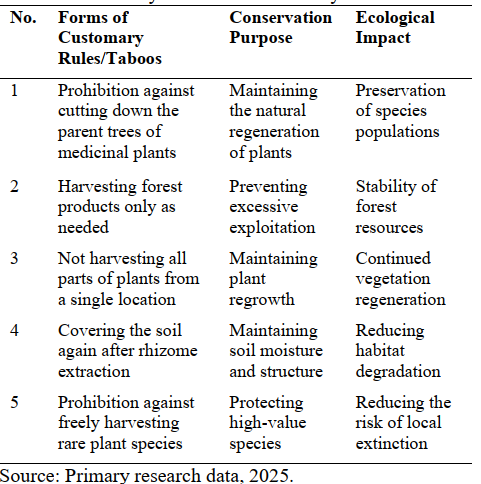
The conservation forest area in Tetebatu Resort, Mount Rinjani National Park, possesses diverse medicinal plants with ecological and cultural value for the Sasak community. This study aimed to analyze the forms of Sasak local wisdom in utilizing medicinal plants and their integration with forest conservation practices. The research employed a descriptive qualitative approach supported by simple quantitative data. Data were collected through in-depth interviews, participatory observation, documentation, and literature study, while informants were selected purposively and expanded using snowball sampling. The findings revealed that medicinal plant utilization is still practiced traditionally through oral transmission and direct practice. The community applies customary rules that support sustainable harvesting, such as prohibiting the cutting of parent trees, collecting plants only as needed, avoiding overharvesting in one area, and restoring soil after rhizome extraction. These practices align with conservation principles by maintaining natural regeneration and forest vegetation structure. The study concludes that Sasak local wisdom functions as a community-based conservation mechanism integrated with formal conservation policies. Therefore, documentation of ethnobotanical knowledge and stronger collaboration between local communities and conservation managers are essential to ensure the sustainability of medicinal plant conservation.
Keywords:
conservation ethnobotany local wisdom medicinal plants Sasak communityReferences
Albuquerque, U. P., De Lucena, R. F. P., da Cunha, L. V. F. C., & Alves, R. R. N. (Eds.). (2019). Methods and techniques in ethnobiology and ethnoecology. Springer, New York: Humana Press.
Bernard, H. R. (2017). Research methods in anthropology: Qualitative and quantitative approaches (6th ed.). Rowman & Littlefield.
Birt, L., Scott, S., Cavers, D., Campbell, C., & Walter, F. (2016). Member checking: A tool to enhance trustworthiness or merely a nod to validation? Qualitative Health Research, 26(13), 1802–1811. https://doi.org/10.1177/1049732316654870
Cahyaningsih, R., Magos Brehm, J., & Maxted, N. (2021). Setting the priority medicinal plants for conservation in Indonesia. Genetic resources and crop evolution, 68(5), 2019-2050. DOI: https://doi.org/10.1007/s10722-021-01115-6
Creswell, J. W., & Creswell, J. D. (2018). Research design: Qualitative, quantitative, and mixed methods approaches (5th ed.). SAGE.
Ens, E., Scott, M. L., Rangers, Y. M., Moritz, C., & Pirzl, R. (2016). Putting indigenous conservation policy into practice delivers biodiversity and cultural benefits. Biodiversity and Conservation, 25, 2889–2906. https://doi.org/10.1007/s10531-016-1207-6
Etikan, I., & Bala, K. (2017). Sampling and sampling methods. Biometrics & Biostatistics International Journal, 5(6), 00149. https://doi.org/10.15406/bbij.2017.05.00149
Febriyanti, R. M., Ramadhania, Z. M., Tjitraresmi, A., Indradi, R. B., Maisyarah, I. T., Maundu, P. M., ... & Sujarwo, W. (2026). A systematic review of ethnobotanical study in Indonesia: diversity and cultural patterns of medicinal plant use. Journal of Ethnobiology and Ethnomedicine. DOI: https://doi.org/10.1186/s13002-026-00879-4
Gadgil, M., Berkes, F., & Folke, C. (1993). Indigenous knowledge for biodiversity conservation. Ambio-Stockholm-, 22, 151-151.. https://doi.org/10.1007/s13280-020-01407-4
Heinrich, M., Lardos, A., Leonti, M., Weckerle, C., Willcox, M., Applequist, W., ... & Stafford, G. (2018). Best practice in research: consensus statement on ethnopharmacological field studies–ConSEFS. Journal of ethnopharmacology, 211, 329-339. https://doi.org/10.1016/j.jep.2017.08.015
Himmi, S. K., Humaedi, M. A., & Astutik, S. (2014). Ethnobiological study of the plants used in the healing practices of an indigenous people Tau Taa Wana in Central Sulawesi, Indonesia. Procedia Environmental Sciences, 20, 841-846. https://doi.org/10.1016/j.proenv.2014.03.102
IPBES. (2019). Global assessment report on biodiversity and ecosystem services. Intergovernmental Science-Policy Platform on Biodiversity and Ecosystem Services.
Jadid, N., Kurniawan, E., Himayani, C. E. S., Andriyani, Prasetyowati, I., Purwani, K. I., ... & Tjahjaningrum, I. T. D. (2020). An ethnobotanical study of medicinal plants used by the Tengger tribe in Ngadisari village, Indonesia. Plos one, 15(7), e0235886. https://doi.org/10.1371/journal.pone.0235886
Martin, G. J. (2014). Ethnobotany: A methods manual. Routledge.
Miles, M. B., Huberman, A. M., & Saldaña, J. (2014). Qualitative data analysis: A methods sourcebook (3rd ed.). SAGE Publications.
Nur Kholis Majid, M., Agustina, A., & Lasekti Wicaksono, R. (2025). Etnobotanical Study of Medicinal Plants by the Community Pucung Village, Kismantoro District, Wonogiri Regency, Central Java. Jurnal Biodjati, 10(2), 378–392. https://doi.org/10.15575/biodjati.v10i2.49761
Pramana, A. F., Azhari, A., Priyanti, P., & Khairiah, A. (2025, December). Studi Etnobotani Tanaman Obat Di Gg. Sudirja, Sukamenak, Margahayu, Bandung. In Prosiding Seminar Nasional Biologi (Vol. 5, No. 1, pp. 1361-1369). DOI: https://doi.org/10.24036/prosemnasbio/vol5/1276
Purwanti, E., Mahmudati, N., Faradila, S. F., & Fauzi, A. (2020, April). Utilization of plants as traditional medicine for various diseases: Ethnobotany study in SUmeNep, Indonesia. In AIP Conference Proceedings (Vol. 2231, No. 1, p. 040024). AIP Publishing LLC. DOI: https://doi.org/10.1063/5.0002430
Quave, C. L., & Pieroni, A. (2015). A reservoir of ethnobotanical knowledge informs resilient food security and health strategies. Nature Plants, 1, 14017. https://doi.org/10.1038/nplants.2014.17
Rani, F. E., & Kustiawan, P. M. (2025). Ethnobotanical Study of Medicinal Plants Among the Paser Telake Tribe in Pinang Jatus Village, East Kalimantan, Indonesia. Jurnal Biodjati, 10(2), 229–241. https://doi.org/10.15575/biodjati.v10i2.4451
Reyes-García, V., et al. (2009). Cultural transmission of ethnobotanical knowledge and skills: An empirical analysis from an Amerindian society. Evolution and Human Behavior, 30(4), 274–285. DOI: https://doi.org/10.1016/j.evolhumbehav.2009.02.001
Silalahi, M., Walujo, E. B., Supriatna, J., & Mangunwardoyo, W. (2015). The local knowledge of medicinal plants trader and diversity of medicinal plants in the Kabanjahe traditional market, North Sumatra, Indonesia. Journal of ethnopharmacology, 175, 432-443. DOI: https://doi.org/10.1016/j.jep.2015.09.009
Srithi, K., et al. (2014). Ethnobotanical study of medicinal plants used by Tai Yai in Northern Thailand. Journal of Ethnopharmacology, 151(2), 829–838. DOI: https://doi.org/10.1016/j.jep.2013.11.033
Sugiyono. (2020). Metode penelitian kuantitatif, kualitatif, dan kombinasi (mixed methods). Alfabeta.
Supiandi, M. I., Mahanal, S., Zubaidah, S., Julung, H., & Ege, B. (2019). Ethnobotany of traditional medicinal plants used by Dayak Desa community in Sintang, West Kalimantan, Indonesia. Biodiversitas, 20(5), 1264-1270. DOI: https://doi.org/10.13057/biodiv/d200516
Turner, N. J., Łuczaj, Ł., Migliorini, P., Pieroni, A., Dreon, A. L., Sacchetti, L. E., & Paoletti, M. G. (2020). Edible and tended wild plants, traditional ecological knowledge and agroecology. Critical Reviews in Plant Sciences, 30(1–2), 198–225. https://doi.org/10.1080/07352689.2011.554492
Ulfa, M., Manurung, H., & Prabuningrum, D. S. (2025). Ethnobotanical Study and Conservation Status of Medicinal Plants Used by Local Community in Desa Namo Bintang, North Sumatra. Journal of Sylva Indonesiana, 9(01), 114-125. DOI: https://doi.org/10.32734/jsi.v9i01.24720
Ulmillah, A., & Widiani, N. (2025). Ethnobotany of Medicinal Plants in Semendo Tribe of Buay Pemaca District. LenteraBio: Berkala Ilmiah Biologi, 14(3), 319-330. DOI: https://doi.org/10.26740/lenterabio.v14n3.p319-330
Wahidah, B. F., Husain, F., Mulyanah, W., & Khasanah, R. (2025). Ethnobotanical Study of Local Wisdom in the Utilization and Conservation of Medicinal Plants for Children's Health Around Mount Muria, Central Java. Komunitas: International Journal of Indonesian Society and Culture, 17(1), 1-13. DOI: https://doi.org/10.15294/komunitas.v17i1.21122
Weckerle, C. S., et al. (2018). Recommended standards for conducting and reporting ethnopharmacological field studies. Journal of Ethnopharmacology, 210, 125–132. DOI: https://doi.org/10.1016/j.jep.2017.08.018
Weking, C. J. P., Hafsah, H., & Lestari, T. R. (2023). study of medicine plants ethnobotany in Banceuy indigenous people Subang Regency, West Java. Media Konservasi, 28(1), 8-16. DOI: https://doi.org/10.29244/medkon.28.1.8-16
Zhang, Y., et al. (2020). Ethnobotany and diversity of medicinal plants used by the Buyi in eastern Yunnan, China. Plant Diversity, 42(6), 401–414. DOI: https://doi.org/10.1016/j.pld.2020.09.004
Quave, C. L., & Pieroni, A. (2015). A reservoir of ethnobotanical knowledge informs resilient food security and health strategies in the Balkans. Nature Plants, 1(2), 14021. https://doi.org/10.1038/nplants.2014.21
Turner, N. J., Cuerrier, A., & Joseph, L. (2022). Well grounded: Indigenous Peoples' knowledge, ethnobiology and sustainability. People and Nature, 4(3), 627-651. https://doi.org/10.1002/pan3.10321