Turtle Conservation for Junior High Social Studies Learning on Natural Resource Conservation
Published:
2026-05-20Downloads
Abstract
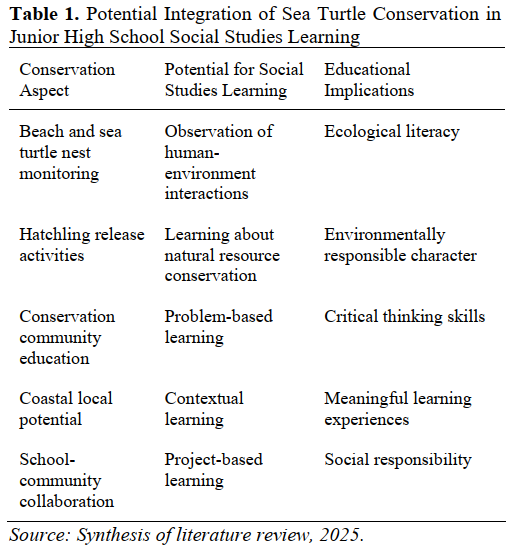
Indonesia is a maritime country with rich marine biodiversity, including sea turtles that play an important ecological role in maintaining the balance of marine ecosystems such as coral reefs and seagrass beds. This study aims to analyze the potential of turtle conservation as an environment-based learning medium in supporting the preservation of natural resources in junior high school Social Studies learning. This research employs a qualitative descriptive approach using literature review and contextual analysis of turtle conservation in Pelangi Beach, Bantul. The findings show that turtle conservation provides strong potential as a contextual learning resource that connects ecological issues with Social Studies concepts, particularly in natural resource management and environmental preservation. In addition, the integration of conservation-based learning enhances students’ environmental awareness, critical thinking skills, and pro-environmental behavior through direct observation, conservation projects, and collaboration with conservation managers. In conclusion, turtle conservation serves not only as an ecological preservation effort but also as an effective contextual learning medium in Social Studies education. Therefore, its integration into the curriculum is recommended to strengthen environmental literacy and foster students’ ecological responsibility through experiential and collaborative learning approaches.
Keywords:
environmental education local potential natural resource conservation social studies learning turtle conservationReferences
Basyarul Aziz, & Azlin Resiana. (2025). Edukasi Peningkatan Pelestarian Konservasi Penyu melalui Permainan Lego Bricks di Desa Apar Kota Pariaman. PaKMas: Jurnal Pengabdian Kepada Masyarakat, 5(2), 566–575. https://doi.org/10.54259/pakmas.v5i2.4063
Berglund, T., Gericke, N., & Chang Rundgren, S.-N. (2014). The implementation of education for sustainable development in Sweden: investigating the sustainability consciousness among upper secondary students. Research in Science & Technological Education, 32(3), 318–339. https://doi.org/10.1080/02635143.2014.944493
Erfariyah, A., Jaenudin, D., & Permana, I. (2024). Development of Conservation E-Books Based on Local Potential to Improve Eco-literacy of Junior High School Students. International Journal of STEM Education for Sustainability, 4(2), 267–292. https://doi.org/10.53889/ijses.v4i2.443
Fajeriadi, H., Azzam, M. N., & Azzahra, F. G. (2025). The effect of local potential-based biology learning resources on students’ competencies: An in-depth analysis. Biosfer, 18(2), 315–326. https://doi.org/10.21009/biosferjpb.54745
Hays, G. C., Laloë, J.-O., & Seminoff, J. A. (2025). Status, trends and conservation of global sea turtle populations. Nature Reviews Biodiversity, 1(2), 119–133. https://doi.org/10.1038/s44358-024-00011-y
Hendrix, H., & Pérez-Espona, S. (2024). A Systematic Review of Population Monitoring Studies of Sea Turtles and Its Application to Conservation. Diversity, 16(3), 177. https://doi.org/10.3390/d16030177
Krippendorff, K. (2019). Content Analysis: An Introduction to Its Methodology. SAGE Publications, Inc. https://doi.org/10.4135/9781071878781
Lin, W.-C., Nguyen, L.-H.-P., Tran, N.-H., & Huang, C.-F. (2022). Impact of an action-oriented environmental education course on students’ environmental awareness. Applied Environmental Education & Communication, 21(4), 331–347. https://doi.org/10.1080/1533015X.2022.2099482
Lopes, L. L., Paulsch, A., & Nuno, A. (2022). Global challenges and priorities for interventions addressing illegal harvest, use and trade of marine turtles. Oryx, 56(4), 592–600. https://doi.org/10.1017/S0030605320001210
Maulana, A. D., Sapriya, S., Mansyur, A. I., & Utami, L. (2024). Integrating Local Environmental Resources into Social Studies Curriculum: A Case Study of Primary Education in Enhancing Environmental Literacy. IJTIMAIYA: Journal of Social Science and Teaching, 8(2), 123. https://doi.org/10.21043/ji.v8i2.29113
Maurer, A. S., Seminoff, J. A., Layman, C. A., Stapleton, S. P., Godfrey, M. H., & Reiskind, M. O. B. (2021). Population Viability of Sea Turtles in the Context of Global Warming. BioScience, 71(8), 790–804. https://doi.org/10.1093/biosci/biab028
Miles, M. B., Huberman, A. M., & Saldaña, J. (2019). Qualitative Data Analysis: A Methods Sourcebook (3th ed.). SAGE Publications.
Nada, H. N., Fajarningsih, R. U., & Astirin, O. P. (2021). Environmental education to build school members’ character. JPBI (Jurnal Pendidikan Biologi Indonesia), 7(1), 43–52. https://doi.org/10.22219/jpbi.v7i1.14283
Nadhiroh, S., & Efendi, N. (2023). Contextual Teaching and Learning (CTL) Approach to Science Learning Outcomes in Grade 4 Elementary Schools. Indonesian Journal of Education Methods Development, 18(1). https://doi.org/10.21070/ijemd.v21i.723
Nahill, B. (2021). Fundraising for Sea Turtle Conservation. In Sea Turtle Research and Conservation (pp. 201–218). Elsevier. https://doi.org/10.1016/B978-0-12-821029-1.00020-9
Ni Putu Dian PertiwI, Suhendro, M. D., Yusmalinda, N. L. A., Putra, I. N. G., Putri, I. G. R. M., Artiningsih, E. Y., AL-Malik, M. D., Cahyani, N. K. D., & Sembiring, A. (2020). Forensic genetic case study: Species identification and traceability of sea turtle caught in illegal trade in Bali, Indonesia. Biodiversitas Journal of Biological Diversity, 21(9). https://doi.org/10.13057/biodiv/d210945
Page, M. J., McKenzie, J. E., Bossuyt, P. M., Boutron, I., Hoffmann, T. C., Mulrow, C. D., Shamseer, L., Tetzlaff, J. M., Akl, E. A., Brennan, S. E., Chou, R., Glanville, J., Grimshaw, J. M., Hróbjartsson, A., Lalu, M. M., Li, T., Loder, E. W., Mayo-Wilson, E., McDonald, S., … Moher, D. (2021). The PRISMA 2020 statement: an updated guideline for reporting systematic reviews. BMJ, n71. https://doi.org/10.1136/bmj.n71
Purwasih, D., Wilujeng, I., Membalik, V., & Hasan, S. (2022). Learning instructional using webbed models based on local potential “Pulau Kembang” to enhance ecological literacy skill. Jurnal Inovasi Pendidikan IPA, 8(2), 131–141. https://doi.org/10.21831/jipi.v8i2.49288
Sass, W., De Maeyer, S., Boeve-de Pauw, J., & Van Petegem, P. (2024). Effectiveness of education for sustainability: the importance of an action-oriented approach. Environmental Education Research, 30(4), 479–498. https://doi.org/10.1080/13504622.2023.2229543
Selmen, D., Ashibly, A., & Fitri, S. N. (2025). Peran Hukum Nasional Dan Internasional Dalam Konservasi Penyu Sebagai Satwa Liar Yang Dilindungi Di Indonesia. TANJUNGPURA LAW JOURNAL, 9(1). https://doi.org/10.26418/tlj.v9i1.67567
Snyder, H. (2019). Literature review as a research methodology: An overview and guidelines. Journal of Business Research, 104, 333–339. https://doi.org/10.1016/j.jbusres.2019.07.039
Suryawan, I. W. K., & Tehupeiory, A. (2023). Strategi Partisipatif Masyarakat dalam Mitigasi Dampak Alami. Indonesian Journal of Conservation, 12(1), 88–100. https://doi.org/10.15294/jsi.v12i1.41919
Suryawati, E., Suzanti, F., Zulfarina, Z., Putriana, A. R., & Febrianti, L. (2020). The Implementation of Local Environmental Problem-Based Learning Student Worksheets to Strengthen Environmental Literacy. Jurnal Pendidikan IPA Indonesia, 9(2), 169–178. https://doi.org/10.15294/jpii.v9i2.22892
Syaputra, R. H., Basuni, S., & Zulbainarni, N. (2025). Sustainability Analysis and Actor Performance in the Governance of the Turtle Conservation Program at the Turtle Conservation and Education Center (TCEC) Bali. Journal of Global Sustainable Agriculture, 214–220. https://doi.org/10.32502/jgsa.v5i3.1114
Tamrin, T., & Taufiq Abdullah. (2024). Konservasi Penyu Melalui Pelepasan Tukik di Pantai Wisata Desa Maitara Kota Tidore Kepulauan. Bakti Hayati: Jurnal Pengabdian Indonesia, 3(2), 55–59. https://doi.org/10.31957/bhjpi.v3i2.4433
van de Wetering, J., Leijten, P., Spitzer, J., & Thomaes, S. (2022). Does environmental education benefit environmental outcomes in children and adolescents? A meta-analysis. Journal of Environmental Psychology, 81, 101782. https://doi.org/10.1016/j.jenvp.2022.101782
Van Poeck, K., Vandenplas, E., & Östman, L. (2024). Teaching action-oriented knowledge on sustainability issues. Environmental Education Research, 30(3), 334–360. https://doi.org/10.1080/13504622.2023.2167939
Wicaksono, B. A., Khotimah, K., Segara, N. B., & Prastiyono, H. (2023). Analisis Potensi Ekosistem Mangrove Center Tuban Sebagai Sumber Belajar Pendidikan Lingkungan Bahari Dalam Pembelajaran IPS. SOSEARCH : Social Science Educational Research, 3(2), 66–80. https://doi.org/10.26740/sosearch.v3n2.p66-80
Wuryandani, W., Fathurrohman, F., & Herwin, H. (2022). The Environmental Utilization as a Learning Resource for Civic Education in Elementary Schools by Prospective Teacher College Students. Jurnal Prima Edukasia, 10(2), 194–200. https://doi.org/10.21831/jpe.v10i2.51923
Xiao, Y., & Watson, M. (2019). Guidance on Conducting a Systematic Literature Review. Journal of Planning Education and Research, 39(1), 93–112. https://doi.org/10.1177/0739456X17723971
Zeno Adi Eti Harnino, T., Nyoman Yoga Parawangsa, I., Aprilianita Sari, L., & Sulastri Arsad. (2021). Efektifitas Pengelolaan Konservasi Penyu di Turtle Conservation andEducation Center Serangan, Denpasar Bali. Journal of Marine and Coastal Science, 10(1). https://e-journal.unair.ac.id/JMCS