An Ethnoscience Study of the Tempe-Making Process as a Source of Contextual Science Learning: A Case Study of The Aikmual Village
DOI:
10.65622/ijei.v2i1.250Downloads
Abstract
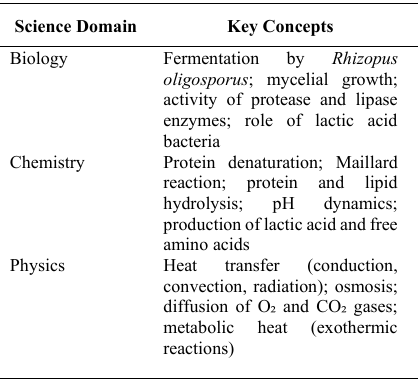
Contextual learning in science education (IPA) demands integration of real-world phenomena familiar to students. This study examines the ethnoscientific aspects embedded in the tempeh-making process as a contextual resource for science learning. A qualitative descriptive case study was conducted in Aikmual Village, Central Lombok, involving participatory observation, in-depth interviews with three experienced producers, and documentation. The findings reveal that the tempeh production process integrates key scientific concepts across biology, chemistry, and physics, particularly in fermentation, biochemical transformations, and heat transfer mechanisms. Eight production stages were systematically mapped to relevant science competencies at the junior and senior high school levels. The study concludes that traditional tempeh-making practices have strong potential as ethnoscience-based learning resources to enhance students’ scientific literacy and contextual understanding, in line with the Merdeka Belajar curriculum.
Keywords:
ethnoscience contextual learning science education tempeh fermentation local knowledgeReferences
Aikenhead, G. S., & Ogawa, M. (2007). Indigenous knowledge and science revisited. Cultural Studies of Science Education, 2(3), 539-620. https://doi.org/10.1007/s11422-007-9067-8
Berk, B. B., & Hamurcu, H. (2022). The effect of ethnoscience-based teaching on science process skills and academic achievement. Journal of Science Education and Technology, 31(4), 488-499. https://doi.org/10.20527/jipf.v7i2.9242
Bravo-Torija, B., & Jimenez-Aleixandre, M. P. (2018). Developing an initial learning progression for the use of evidence in open-ended problems. International Journal of Science Education, 40(9), 977-1002. https://doi.org/10.1007/s10763-017-9803-9
Chinn, P. W. U. (2007). Decolonizing methodologies and indigenous knowledge: The role of culture, place and personal experience in professional development. Journal of Research in Science Teaching, 44(9), 1247-1268. https://doi.org/10.1002/tea.20192
Corsetti, P. R., & de Lima, J. O. G. (2023). Ethnoscience in chemistry and biology teaching: A systematic review. Science & Education, 32(1), 211-238. https://doi.org/10.1007/s11191-021-00299
Creswell, J. W. (2009). Research Design: Qualitative, Quantitative, and Mixed Methods Approaches. SAGE Publications.
Dawson, V. (2018). Western science and traditional knowledge: Understanding their relationship in science education. Research in Science Education, 48(3), 581-598. https://doi.org/10.1038/sj.embor.7400693
Diatmika, I. K. N. (2018). Penerapan pembelajaran kontekstual untuk meningkatkan hasil belajar IPA. Jurnal Ilmiah Sekolah Dasar, 2(4), 436-445. https://doi.org/10.23887/jisd.v2i4.16165
Dwinaningsih, E. A. (2010). Karakteristik kimia dan sensori tempe dengan variasi bahan baku kedelai/beras dan penambahan angkak serta variasi lama fermentasi. Skripsi. Universitas Sebelas Maret, Surakarta.
Elisa, E., Prabandi, A. M., Istighfarini, E. T., Alivia, H., Inayah H., L. W., & Nuraini, L. (2022). Analisis konsep-konsep fisika berbasis kearifan lokal pada jajanan tradisional dawet dan klepon. ORBITA: Jurnal Pendidikan Dan Ilmu Fisika, 8(2), 194. https://doi.org/10.31764/orbita.v8i2.10197
Espinoza-Herold, M., & Gonzalez-Carriedo, R. (2017). Issues in Latino Education: Race, School Culture, and the Politics of Academic Success. Routledge.
Hadi, W. P., & Ahied, M. (2017). Kajian etnosains Madura dalam proses produksi garam sebagai media pembelajaran IPA terpadu. Jurnal Ilmiah Rekayasa, 10(2), 79-86.
Hadi, W. P., Sari, F. P., Nugroho, A., Mawaddah, W., & Arifin, S. (2019). Terasi Madura: Kajian etnosains dalam pembelajaran IPA untuk menumbuhkan nilai kearifan lokal dan karakter siswa. Quantum: Jurnal Inovasi Pendidikan Sains, 10(1), 45-55.
Henze, I., & van Driel, J. H. (2009). Towards a more comprehensive way to capture PCK in its complexity. Journal of Research in Science Teaching, 46(6), 771-791. https://doi.org/10.1002/tea.20303
Johnson, A., & Sinatra, G. M. (2020). Connecting prior knowledge to new science learning: Implications for contextual instruction. Science Education, 104(3), 412-440. https://doi.org/10.1002/sce.21560
Kartika, T., Ertikanto, C., & Wahyudi, I. (2018). The influence of science learning based on local wisdom toward students’ concept mastery and scientific attitude. Journal of Physics: Conference Series, 1013(1), 012035. https://doi.org/10.1088/1742-6596/1013/1/012035
Kemdikbud. (2022). Tentang Kurikulum Merdeka. Pusat Informasi Guru Kemdikbud.
Kholidah, L. N., Hidayat, S., Jamaludin, U., & Leksono, S. M. (2023). Kajian etnosains dalam pembelajaran IPA untuk menumbuhkan nilai kearifan lokal dan karakter siswa SD melalui sate bandeng (Chanos chanos). Pendas: Jurnal Ilmiah Pendidikan Dasar, 8(2), 4165-4177.
Kim, M., & Tan, A. L. (2013). A rethinking of pedagogical content knowledge in science education: Collaboration and co-construction of science lessons. International Journal of Science Education, 35(7), 1202-1224. https://doi.org/10.3390/encyclopedia6020043
Ladwig, A., & Rhee, J. (2021). Fermented food as pedagogical resource: Integrating ethnoscience into STEM curricula. Journal of Biological Education, 55(3), 267-280. https://doi.org/ 10.46843/jiecr.v6i2.2230
Lidi, M. W., Mbia Wae, V. P. S., & Umbu Kaleka, M. B. (2022). Implementasi etnosains dalam pembelajaran IPA untuk mewujudkan merdeka belajar di Kabupaten Ende. OPTIKA: Jurnal Pendidikan Fisika, 6(2), 206-216. https://doi.org/10.37478/optika.v6i2.2218
Mensah, F. M. (2011). A case for culturally relevant teaching in science education and lessons learned for teacher education. The Journal of Negro Education, 80(3), 296-309.
Merriam, S. B., & Tisdell, E. J. (2016). Qualitative Research: A Guide to Design and Implementation (4th ed.). Jossey-Bass.
Molina-Andrade, A., & Utges, G. (2011). Science teachers’ conceptions of the nature of science and of scientific phenomena. Cultural Studies of Science Education, 6(2), 447-472. https://doi.org/10.1007/s42087-021-00257-4
Mukti, H., Suastra, I. W., & Aryana, I. B. P. A. (2022). Integrasi etnosains dalam pembelajaran IPA. JPGI (Jurnal Penelitian Guru Indonesia), 7(1), 36-42. https://doi.org/10.33503/ebio.v4i02.437
Nesse, J., Holt, E. A., & Milner, A. R. (2020). Contextual teaching in science: Students develop scientific literacy through local cultural practice. International Journal of Science and Mathematics Education, 18(5), 911-927. https://doi.org/10.37251/jee.v7i1.2378
Noh, T., & Scharmann, L. C. (1997). Instructional influence of a molecular-level pictorial presentation of matter on students’ conceptions and problem-solving ability. Journal of Research in Science Teaching, 34(2), 199-217. https://doi.org/10.1002/(SICI)1098-2736(199702)34:2<199::AID-TEA6>3.0.CO;2-O
Nuraini, V., Puyanda, I. R., Kunciati, W. A. S., & Margareta, L. A. (2021). Perubahan kimia dan mikrobiologi tempe busuk selama fermentasi. Jurnal Agroteknologi, 15(2), 127-137. https://doi.org/10.19184/j-agt.v15i02.25729
Nurholipah, N., & Ayun, Q. (2021). Isolasi dan identifikasi Rhizopus oligosporus dan Rhizopus oryzae pada tempe asal Bekasi. Jurnal Teknologi Pangan, 15(1), 98-104. https://doi.org/10.33005/jtp.v15i1.2742
Odora Hoppers, C. A. (2001). Indigenous knowledge systems and academic institutions in South Africa. Perspectives in Education, 19(1), 73-85.
Ottander, C., & Ekborg, M. (2012). Students’ experience of working with socioscientific issues: A quantitative study in secondary school. Research in Science Education, 42(6), 1147-1163. https://doi.org/10.1007/s11165-011-9238-1
Purnomo, D., Susilowati, S. M. E., & Ridlo, S. (2020). Ethnoscience-based integrated science learning: Analysis of local wisdom on traditional food processing in Indonesia. Journal of Physics: Conference Series, 1567(4), 042027. https://doi.org/10.1088/1742-6596/1567/4/042027
Putri, V. Z., Rahmadea, S. A., Az-zahra, A. S., Kristiani, L., Fahzrial, L. H. I., & Ratnasari, Y. (2024). Analisis Pemahaman Konsep Perubahan Wujud Zat Melalui Pratikum Pembuatan Es Krim Putar. Jurnal Belaindika: Pembelajaran dan Inovasi Pendidikan, 6(2), 145-155. https://doi.org/10.52005/belaindika.v6i2.225
Rahmawati, D., & Nurhayati, N. (2022). Perubahan pH dan kelarutan mineral selama fermentasi tempe oleh Rhizopus oligosporus. Jurnal Gizi dan Pangan, 17(2), 89–97.
Rigolon, W., Khor, G. L., Lim, S. L., & Woo, K. L. (2022). Traditional fermented soybean foods and their microbiology in Southeast Asia: A review. Food Control, 134, 108750. https://doi.org/10.1016/j.foodcont.2021.108750
Sari, S. P., Mapuah, S., & Sunaryo, I. (2021). Pembelajaran ilmu pengetahuan alam berbasis etnosains untuk mengembangkan kemampuan berpikir kritis siswa sekolah dasar. EduBase: Journal of Basic Education, 2(1), 9-18. https://doi.org/10.47453/edubase.v2i1.284
Sari, W. P., Marbun, T., Kirani, N. S., Ramadhan, M. I. R., & Utomo, A. P. Y. (2022). Pengaruh mikroba dalam proses fermentasi pembuatan tempe. Jurnal Ilmiah Dan Karya Mahasiswa, 2(3), 85–95. https://doi.org/10.54066/jikma.v2i3.1925
Semali, L. M., & Kincheloe, J. L. (Eds.). (1999). What Is Indigenous Knowledge? Voices from the Academy. Falmer Press.
Sholeha, R. (2025). Pemetaan konsep gaya dalam proses pembuatan lepet pada konsep dasar IPA SD. Research and Development Journal of Education, 11(1), 1-12. https://doi.org/10.30998/rdje.v11i1.11196
Soja, L., Nakitto, A., & Diiro, G. (2021). Integrating indigenous knowledge in science curricula: Evidence from East African primary schools. International Journal of Educational Research, 109, 101810. https://doi.org/10.1016/j.ijer.2021.101810
Stake, R. E. (1995). The Art of Case Study Research. SAGE Publications.
Sudarmin. (2014). Pendidikan Karakter, Etnosains dan Kearifan Lokal: Konsep dan Penerapannya dalam Penelitian dan Pembelajaran Sains. Universitas Negeri Semarang.
Sugiyono. (2018). Metode Penelitian Kuantitatif, Kualitatif, dan R&D. Alfabeta.
Susiloningsih, W. (2016). Model pembelajaran CTL (contextual teaching and learning) dalam meningkatkan hasil belajar mahasiswa PGSD pada mata kuliah konsep IPS Dasar. PEDAGOGIA: Jurnal Pendidikan, 5(1), 57-68. https://doi.org/10.21070/pedagogia.v5i1.91
Taber, K. S. (2019). The Nature of Science and Science Education: Foundations and Strategies. Springer.
Utami, R., Widodo, A., & Rustaman, N. Y. (2021). Integrating ethnoscience in science learning: A systematic literature review. Journal of Physics: Conference Series, 1806(1), 012046. https://doi.org/10.1088/1742-6596/1806/1/012046
Wahyudi, A. (2018). Pengaruh variasi suhu ruang inkubasi terhadap waktu pertumbuhan Rhizopus oligosporus pada pembuatan tempe kedelai. Jurnal Redoks, 1(3), 37-44. https://doi.org/10.31851/redoks.v3i1.2790
Widiastuti, N. L. G. K. (2021). E-modul dengan pendekatan kontekstual pada mata pelajaran IPA. Jurnal Ilmiah Pendidikan Dan Pembelajaran, 5(3), 435-445. https://doi.org/10.23887/jipp.v5i3.37974
Winarno, F. G. (2021). Kimia Pangan dan Gizi (Edisi Revisi). Gramedia Pustaka Utama
Yin, R. K. (2018). Case Study Research and Applications: Design and Methods (6th ed.). SAGE Publications.