Integration of Ethnoscience in the Development of a Problem-Based Learning–Based Science E-Module as a Contextual Learning Medium
DOI:
10.65622/ijei.v2i1.251Downloads
Abstract
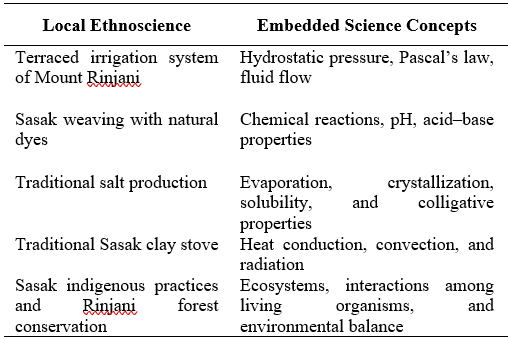
This study developed a Problem-Based Learning (PBL)-based science e-module integrating local ethnoscience from Lombok, Indonesia, and examined its validity, practicality, and effectiveness in improving students’ problem-solving skills and cognitive outcomes. Using the ADDIE model within a Research and Development (R&D) framework combined with a quasi-experimental design, four ethnoscience contexts of the Sasak community, traditional weaving dye techniques, Rinjani terraced irrigation, coastal salt production, and clay stove cooking, were systematically embedded as authentic problem scenarios across five PBL phases. Expert validation yielded a mean score of 90.1% (very valid). Student response surveys indicated 88.4% practicality. Pre-test and post-test analysis using N-gain showed a score of 0.63 (moderate-high) for the experimental group versus 0.35 for the control group, with a statistically significant difference (p < 0.001). Problem-solving skills improved across all four Polya indicators (N-gain 0.52–0.61). The ethnoscience-PBL e-module constitutes a contextually grounded digital learning medium that enhances scientific competence while valorizing indigenous cultural knowledge within the Merdeka Belajar curriculum.
Keywords:
e-module ethnoscience local wisdom Problem-based learning problem-solvingReferences
Arends, R. I. (2012). Learning to Teach (9th ed.). McGraw-Hill Education.
Branch, R. M. (2009). Instructional Design: The ADDIE Approach. Springer. https://doi.org/10.1007/978-0-387-09506-6
Cahyani, H., de Boer, W., Brakels, M., & Stolk, M. (2021). The impact of culturally contextualized science education on students' learning motivation: A mixed-methods study. International Journal of Science Education, 43(10), 1598–1618. https://doi.org/10.1080/09500693.2021.1920851
Elisa, E., Prabandi, A. M., Istighfarini, E. T., Alivia, H., Inayah, L. W., & Nuraini, L. (2022). Analisis konsep-konsep fisika berbasis kearifan lokal pada jajanan tradisional dawet dan klepon. ORBITA: Jurnal Pendidikan Dan Ilmu Fisika, 8(2), 194. https://doi.org/10.31764/orbita.v8i2.10197
Hadi, W. P., & Ahied, M. (2017). Kajian etnosains Madura dalam proses produksi garam sebagai media pembelajaran IPA terpadu. Jurnal Ilmiah Rekayasa, 10(2), 79–86.
Hadi, W. P., Sari, F. P., Nugroho, A., Mawaddah, W., & Arifin, S. (2019). Terasi Madura: Kajian etnosains dalam pembelajaran IPA untuk menumbuhkan nilai kearifan lokal dan karakter siswa. Quantum: Jurnal Inovasi Pendidikan Sains, 10(1), 45–55.
Hake, R. R. (1998). Interactive-engagement versus traditional methods: A six-thousand-student survey of mechanics test data for introductory physics courses. American Journal of Physics, 66(1), 64–74. https://doi.org/10.1119/1.18809
Hmelo-Silver, C. E. (2004). Problem-based learning: What and how do students learn? Educational Psychology Review, 16(3), 235–266. https://doi.org/10.1023/B:EDPR.0000034022.16470.f3
Huang, R., Tlili, A., Chang, T. W., Zhang, X., Nascimbeni, F., & Burgos, D. (2020). Disrupted classes, undisrupted learning during COVID-19 outbreak in China: Application of open educational practices and resources. Smart Learning Environments, 7(1), 1–15. https://doi.org/10.1186/s40561-020-00125-8
Iqlima, S., & Syukur, A. (2025). Kajian etnosains dalam proses pembuatan tempe sebagai sumber pembelajaran kontekstual IPA: Studi kasus Desa Aikmual. Jurnal Pendidikan IPA Indonesia, 14(1), 1–15.
Kemdikbud. (2022). Tentang Kurikulum Merdeka. Pusat Informasi Guru Kemdikbud. https://pusatinformasi.guru.kemdikbud.go.id/hc/en-us/articles/6824331505561
Lidi, M. W., Mbia Wae, V. P. S., & Umbu Kaleka, M. B. (2022). Implementasi etnosains dalam pembelajaran IPA untuk mewujudkan merdeka belajar di Kabupaten Ende. OPTIKA: Jurnal Pendidikan Fisika, 6(2), 206–216.
Mayer, R. E. (2009). Multimedia Learning (2nd ed.). Cambridge University Press. https://doi.org/10.1017/CBO9780511811678
Mukti, H., Suastra, I. W., & Aryana, I. B. P. A. (2022). Integrasi etnosains dalam pembelajaran IPA. JPGI (Jurnal Penelitian Guru Indonesia), 7(1), 36–42.
Nasution, S. (2017). Berbagai Pendekatan dalam Proses Belajar dan Mengajar. Bumi Aksara.
OECD. (2023). PISA 2022 Results (Volume I): The State of Learning and Equity in Education. OECD Publishing. https://doi.org/10.1787/53f23881-en
Polya, G. (1957). How to Solve It: A New Aspect of Mathematical Method (2nd ed.). Princeton University Press.
Riduwan. (2015). Skala Pengukuran Variabel-variabel Penelitian. Alfabeta.
Sari, S. P., Mapuah, S., & Sunaryo, I. (2021). Pembelajaran ilmu pengetahuan alam berbasis etnosains untuk mengembangkan kemampuan berpikir kritis siswa sekolah dasar. EduBase: Journal of Basic Education, 2(1), 9–18.
Savery, J. R. (2006). Overview of problem-based learning: Definitions and distinctions. Interdisciplinary Journal of Problem-Based Learning, 1(1), 9–20. https://doi.org/10.7771/1541-5015.1002
Setyowati, R., Parmin, P., & Widiyatmoko, A. (2020). Developing science module based on problem-based learning to improve students' creative thinking skills. Journal of Innovative Science Education, 9(3), 87–95.
Suastra, I. W., & Tika, K. (2011). Efektivitas model pembelajaran sains berbasis budaya lokal untuk mengembangkan kompetensi dasar sains dan nilai kearifan lokal di SMP. Jurnal Penelitian dan Pengembangan Pendidikan, 5(3), 258–274.
Sudarmin. (2014). Pendidikan Karakter, Etnosains dan Kearifan Lokal: Konsep dan Penerapannya dalam Penelitian dan Pembelajaran Sains. Universitas Negeri Semarang.
Sugiyono. (2019). Metode Penelitian Kuantitatif, Kualitatif, dan R&D (Edisi 2). Alfabeta.
Susiloningsih, W. (2016). Model pembelajaran CTL (contextual teaching and learning) dalam meningkatkan hasil belajar mahasiswa PGSD pada mata kuliah konsep IPS Dasar. PEDAGOGIA: Jurnal Pendidikan, 5(1), 57–68. https://doi.org/10.21070/pedagogia.v5i1.91
Sweller, J., van Merriënboer, J. J. G., & Paas, F. (2019). Cognitive architecture and instructional design: 20 years later. Educational Psychology Review, 31(2), 261–292. https://doi.org/10.1007/s10648-019-09465-5
Widiastuti, N. L. G. K. (2021). E-modul dengan pendekatan kontekstual pada mata pelajaran IPA. Jurnal Ilmiah Pendidikan dan Pembelajaran, 5(3), 435–445. https://doi.org/10.23887/jipp.v5i3.37974
Zimmerman, B. J. (2002). Becoming a self-regulated learner: An overview. Theory Into Practice, 41(2), 64–70. https://doi.org/10.1207/s15430421tip4102_2