The Effect of Ethnoscience-Integrated Science Teaching Materials on Junior High School Students’ Scientific Literacy
DOI:
10.65622/ijei.v2i1.263Downloads
Abstract
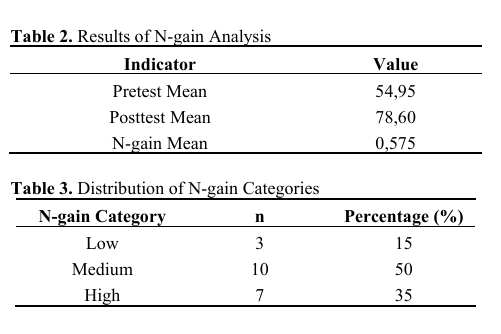
Scientific literacy is an essential competency in twenty-first-century science education, yet Indonesian students’ achievement in this area remains relatively low. One possible contributing factor is the limited availability of contextual teaching materials that connect formal science concepts with students’ sociocultural environment. This study aimed to analyze the effect of ethnoscience-integrated science teaching materials on eighth-grade students’ scientific literacy at MTs. Birrul Walidaini NW Bertong. The study employed a quantitative pre-experimental method with a one-group pretest-posttest design involving 20 students selected through saturated sampling. Data were collected using a scientific literacy test and analyzed descriptively and inferentially through normalized gain (N-gain), the Shapiro-Wilk normality test, and a paired-sample t-test. The results showed a statistically significant increase in students’ scientific literacy (p < 0.05), with the mean score rising from 54.95 on the pretest to 78.60 on the posttest, and an average N-gain of 0.575, placing it in the medium category. These findings suggest that ethnoscience-integrated teaching materials are highly effective in improving scientific literacy, particularly when implemented through guided inquiry with adequate teacher scaffolding, by bridging abstract scientific concepts with students’ everyday cultural realities. The study provides empirical support for culturally responsive, context-based science learning and offers practical implications for the development of science teaching materials in madrasah settings.
Keywords:
ethnoscience contextual learning scientific literacy teaching materialsReferences
Afifah, S., Mudzakir, A., & Nandiyanto, A. B. D. (2022). How to calculate paired sample t-test using SPSS software: From step-by-step processing for users to the practical examples in the analysis of the effect of application anti-fire bamboo teaching materials on student learning outcomes. Indonesian Journal of Teaching in Science, 2(1), 81-92. DOI: https://doi.org/10.17509/ijotis.v2i1.45895
Alifa, F. N., & Zainil, M. (2025). Etnosains Dalam Pendidikan: Memperkuat Identitas Dan Pengetahuan Sains. Sindoro: Cendikia Pendidikan, 15(3), 1-10. DOI: https://doi.org/10.99534/ezeebg15
Almeida, B., Santos, M., & Justi, R. (2023). Aspects and abilities of science literacy in the context of nature of science teaching. Science & Education, 32(3), 567-587. https://doi.org/10.1007/s11191-022-00324-4
Andayani, Y., Purwoko, A. A., Jamaluddin, J., Makhrus, M., & Harjono, A. (2020). Identifikasi pemahaman guru tentang pengembangan perangkat pembelajaran IPA SMP dengan pendekatan etnosain. Jurnal Pepadu, 1(2), 229-234. https://elibrary.ru/item.asp?id=78749421
Astiti, K. A., & Yusuf, Y. H. M. (2018). Pengaruh penggunaan bahan ajar berbasis kontekstual terhadap peningkatan pemahaman konsep fisika siswa materi suhu dan kalor. Jurnal Fisika: Fisika Sains Dan Aplikasinya, 3(2), 185-192. DOI: https://doi.org/10.35508/fisa.v3i2.625
Atmojo, S. E., Anggriani, M. D., Rahmawati, R. D., Skotnicka, M., Wardana, A. K. & Anindya, A. P. (2025). Bridging STEM and Culture: The Role of Ethnoscience in Developing Critical Thinking and Cultural Literacy. Jurnal Pendidikan IPA Indonesia, 14(2). DOI: 10.15294/jpii.v14i2.23505.
Bossér, U. (2024). Transformation of school science practices to promote functional scientific literacy. Research in science education, 54(2), 265-281. DOI: https://doi.org/10.1007/s11165-023-10138-1
Dewi, C. A., Erna, M., Martini, Haris, I. & Kundera, I. N. (2021). The Effect of Contextual Collaborative Learning Based Ethnoscience to Increase Students’ Scientific Literacy Ability. Journal of Turkish Science Education, 18(3): 525–541. DOI: 10.36681/tused.2021.88.
Dewi, C. A., Khery, Y. & Erna, M. (2019). An Ethnoscience Study in Chemistry Learning to Develop Scientific Literacy. Jurnal Pendidikan IPA Indonesia, 8(2): 279–287. DOI: 10.15294/jpii.v8i2.19261.
Dwianto, A., Wilujeng, I., Prasetyo, Z. K. & Suryadarma, I. G. P. (2017). The Development of Science Domain Based Learning Tool Which Is Integrated with Local Wisdom to Improve Science Process Skill and Scientific Attitude. Jurnal Pendidikan IPA Indonesia, 6(1): 23–31. DOI: 10.15294/jpii.v6i1.7205.
Fuadi, H., Robbia, A. Z., Jamaluddin, J., & Jufri, A. W. (2020). Analisis faktor penyebab rendahnya kemampuan literasi sains peserta didik. Jurnal Ilmiah Profesi Pendidikan, 5(2), 108-116. https://scholar.archive.org/work/kiap54erzvgbbmbjak3gezr24q/access/wayback/http://www.jipp.unram.ac.id/index.php/jipp/article/download/122/110
Haryadi, R., & Nurmala, R. (2021). Pengembangan bahan ajar fisika kontekstual dalam meningkatkan motivasi belajar siswa. SPEKTRA: Jurnal Kajian Pendidikan Sains, 7(1), 32-39.
Hikmah, N., Yohandri, Arsih, F., Azhar, M. & Razak, A. (2025). Uncovering the Potential of Ethnoscience in Science Learning to Improve Students’ Literacy: A Systematic-Literature Review (2014–2024). Jurnal Pendidikan IPA Indonesia, 14(3).
Hüfner, S., Weirauch, K., List, F., Menthe, J., & Abels, S. (2025). Context-based science education to promote diversity-equity-inclusion–a systematic literature review on the understanding of context in science education. Studies in Science Education, 1-41. DOI: https://doi.org/10.1080/03057267.2025.2563946
Ke, L., Sadler, T. D., Zangori, L. & Friedrichsen, P. J. (2021). Developing and Using Multiple Models to Promote Scientific Literacy in the Context of Socio-Scientific Issues. Science & Education, 30(3): 589–607. DOI: 10.1007/s11191-021-00206-1.
Knapp, T. R. (2016). Why is the one-group pretest–posttest design still used?. Clinical nursing research, 25(5), 467-472. DOI: https://doi.org/10.1177/1054773816666280
Latip, A., Hernani & Kadarohman, A. (2024). Local and Indigenous Knowledge (LIK) in Science Learning: A Systematic Literature Review. Journal of Turkish Science Education, 21(4): 651–667. DOI: 10.36681/tused.2024.035.
Mashami, R. A., Ahmadi, A. & Pahriah, P. (2025). Green Chemistry and Cultural Wisdom: A Pathway to Improving Scientific Literacy among High School Students. Social Sciences & Humanities Open, 11: 101653. DOI: 10.1016/j.ssaho.2025.101653.
Michie, M., Hogue, M., & Rioux, J. (2023). Two-Ways thinking and Two-Eyed Seeing as ways of implementing Indigenous perspectives in the science education curriculum. Disciplinary and Interdisciplinary Science Education Research, 5(1), 23. DOI: https://doi.org/10.1186/s43031-023-00084-3
Moemeke, C. D., Chukwunenye, J. N., & Malik, N. A. (2025). Understanding the Theoretical Foundations of Inquiry-Based Learning: Pivot For Productive Science Eduation in Africa. Educational Considerations, 50(3), 4. https://newprairiepress.org/edconsiderations/vol50/iss3/4/
OECD. (2023). PISA 2022 Results (Volume I): The State of Learning and Equity in Education. Paris: OECD Publishing. DOI: 10.1787/53f23881-en.
Pinneo, L. & Benton, A. L. (2024). Culturally Responsive Elementary Science Teaching: A Meta-Analysis of Current Science Teaching Studies and Implications. Cultural Studies of Science Education, 19(4): 553–572. DOI: 10.1007/s11422-024-10222-6.
Purnawati, A., & Yakin, N. (2025). Implementasi Kemampuan Literasi Sains dalam Pembelajaran IPA Terintegrasi di Sekolah Dasar. Action Research Journal, 2(2), 107-120. DOI: https://doi.org/10.63987/arj.v2i2.204
Ramdani, A., & Artayasa, I. P. (2023). Pelatihan Pengembangan Bahan Ajar IPA Berbasis Inkuiri Terintegrasi Kearifan Lokal Sebagai Sumber Belajar Guru Madrasah Tsanawiyah Qamarul Huda Bagu. Jurnal Pengabdian Magister Pendidikan IPA, 6(4), 631-635. DOI: 10.29303/jpmpi.v6i4.6610.
Rasmawan, R., Haryani, S., Susilaningsih, E. & Handayani, L. (2025). Integrating Indigenous Knowledge in Science Education: A Systematic Review of Strategies, Models, and Impacts. Journal of Teaching and Learning, 19(5): 206–225. DOI: 10.22329/jtl.v19i5.9444.
Saefullah, A., Samanhudi, U., Nulhakim, L., Berlian, L., Rakhmawan, A., Rohimah, B. & El Islami, R. A. Z. (2017). Efforts to Improve Scientific Literacy of Students through Guided Inquiry Learning Based on Local Wisdom of Baduy’s Society. Jurnal Penelitian dan Pembelajaran IPA, 3(2): 84–91. DOI: 10.30870/jppi.v3i2.2482.
Setiawan, B., Innatesari, D. K., Sabtiawan, W. B. & Sudarmin. (2017). The Development of Local Wisdom-Based Natural Science Module to Improve Science Literation of Students. Jurnal Pendidikan IPA Indonesia, 6(1): 49–54. DOI: 10.15294/jpii.v6i1.9595.
Sjöström, J. (2025). Vision III of scientific literacy and science education: an alternative vision for science education emphasising the ethico-socio-political and relational-existential. Studies in Science Education, 61(2), 239-274. DOI: https://doi.org/10.1080/03057267.2024.2405229
Sugiyono. (2019). Metode Penelitian Kuantitatif, Kualitatif, dan R&D. Bandung: Alfabeta. ISBN: 978-602-289-533-6.
Suryanti, S., Mariana, N., Yermiandhoko, Y. & Widodo, W. (2020). Local Wisdom-Based Teaching Material for Enhancing Primary Students’ Scientific Literacy Skill. Jurnal Prima Edukasia, 8(1): 96–105. DOI: 10.21831/jpe.v8i1.32898.
Utami, A. F., Prasetya, A. T. & Sumarni, W. (2025). Development of Problem-Based Learning (PBL) Ethnoscience Based Teaching Materials Food and Beverage Additives Material to Improve Students’ Science Literacy. Unnes Science Education Journal, 14(3): 553–561. DOI: 10.15294/usej.v14i3.37400.
Valladares, L. (2021). Scientific Literacy and Social Transformation: Critical Perspectives About Science Participation and Emancipation. Science & Education, 30(3): 557–587. DOI: 10.1007/s11191-021-00205-2.
Yacoubian, H. A. (2018). Scientific literacy for democratic decision-making. International Journal of Science Education, 40(3), 308-327. DOI: https://doi.org/10.1080/09500693.2017.1420266
Zidny, R., Sjöström, J., & Eilks, I. (2020). A multi-perspective reflection on how indigenous knowledge and related ideas can improve science education for sustainability. Science & education, 29(1), 145-185. DOI: https://doi.org/10.1007/s11191-019-00100-x
Zidny, R., Solfarina, S., Aisyah, R. S. S. & Eilks, I. (2021). Exploring Indigenous Science to Identify Contents and Contexts for Science Learning in Order to Promote Education for Sustainable Development. Education Sciences, 11(3): 114. DOI: 10.3390/educsci11030114.
Zulirfan, Yennita, Maaruf, Z. & Sahal, M. (2023). Ethnoscientific Literacy in Pacu Jalur Tradition: Can Students Connect Science with Their Local Culture? Eurasia Journal of Mathematics, Science and Technology Education, 19(1): em2210.10.29333/ejmste/12773.